The relationship
between the Jewish people and Jerusalem goes back to pre-Roman times. The
following shows the campaign by the Romans against Jerusalem, destroying its that time Temple. Any tourist walking under the “Arch
of Titus” in Rome completed in 81 CE, can see the following image:
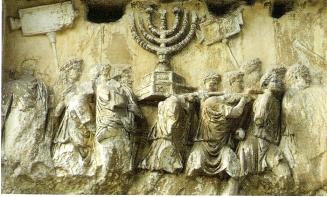
More
recent archaeological excavations carried out near the Temple Mount,
uncovered a terraced street from the Herodian era, extended 600 meters to the
Temple. The excavators think the drainage canals under the street are those
mentioned by contemporary historian Josephus Flavius- who said the Romans
trapped the Jews who hid under the streets.
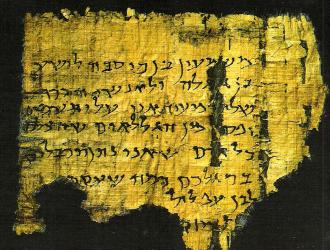
In
the following letter by Bar Kochba, written during (a next) revolt against
Rome in 132-135 CE, he seeks to recruit "Galileans," which some
scholars interpreted as Christians. Emperor Hadrian
however, feared the revolt could spark the hopes of enslaved peoples across the
Roman Empire. (G.W. Bowerstock, "A Roman
Perspective on the Bar Kochba War," in W. S. Green, ed., Approaches to
Ancient Judaism, 2, 1980).
In spite of popular believe, on the
other hand Jerusalem is not connected to any events in Muhammad's life and is
not mentioned in the Koran.
It was in the century after
Muhammad's death, that politics, prompted the Damascus-based Umayyad dynasty,
which controlled Jerusalem, to make this city sacred in Islam. Embroiled in
fierce competition with a dissident leader in Mecca, the Umayyad rulers were
seeking to diminish Arabia at Jerusalem's expense. They sponsored a genre of
literature praising the "virtues of Jerusalem" and circulated
re-invented accounts of the prophet's sayings or doings (called hadiths)
favorable to Jerusalem. In 688-91, they built the Dome of the Rock, on top of
the remains of the Jewish Temple. They also were the ones that reinterpreted
the Koran to make room for Jerusalem.
However, when the Umayyad dynasty
collapsed in 750, Jerusalem fell into near-obscurity.
For the next three and a half centuries, texts praising the city lost favor and
the construction of glorious buildings not only stopped, but existing ones fell
apart (the Dome over the rock collapsed in 1016).
Judaism to compare this with the
above has made Jerusalem a holy city over three thousand years ago and through
all that time Jews remained steadfast to it. Jews pray in its direction,
mention its name constantly in prayers, close the Passover service with the
wistful statement "Next year in Jerusalem," and recall the city in
the blessing at the end of each meal. The destruction of the Temple looms very
large in Jewish consciousness; remembrance takes such forms as a special day of
mourning, houses left partially unfinished, a woman's makeup or jewelry left
incomplete, and a glass smashed during the wedding ceremony. In addition,
Jerusalem has had a prominent historical role, is the only capital of a Jewish
state, and is the only city with a Jewish majority during the whole of the past
century. In the words of its current mayor, Jerusalem represents "the
purist expression of all that Jews prayed for, dreamed of, cried for, and died
for in the two thousand years since the destruction of the Second Temple."
One comparison makes this point most
clearly: Jerusalem appears in the Jewish Bible 669 times and Zion (which
usually means Jerusalem, sometimes the Land of Israel) 154 times, or 823 times
in all. The Christian Bible mentions Jerusalem 154 times and Zion 7 times. In
contrast Jerusalem or/and Zion appear not even once in the Qur'an.
So why does it now loom so large for
Muslims? Why does King Fahd of Saudi Arabia call on Muslim states to protect
"the holy city [that] belongs to all Muslims across the world"? Why
suddenly do Muslims all over the world find Jerusalem one of their most
pressing foreign policy issue?
Because of politics. An historical
survey shows that the stature of the city, and the emotions surrounding it,
inevitably rises for Muslims when Jerusalem has political
significance.
The inhabitants of what now is called
Palestine and Israel, at the start of the 20th Cent. considered themselves
part of the Ottoman dominated Syrian provinces. Arab nationals from Nablus,
Jerusalem and Jaffa considered themselves Ottomans or Syrians. The idea to
call themselves 'Palestinians' came as a reaction to increasing
migration by Zionist settlers from Europe especially after WWI.
A recent study using archival
material describes the radicalization of this Palestinian movement, see underneath here
The
Jerusalem Problem
In order to inflame Muslim opinion during the 1920’s, Arab
nationalists under the leadership of Hajj Amin al-Husseini circulated doctored
photographs of a Jewish flag with the Star of David flying over the Dome of the
Rock. Hajj Amin al-Husseini also instigated a move to change the paved area in
front of the generally recognized to be Jewish-Wailing (Western) Wall, which
was transformed from a cul-de-sac into an open thoroughfare. The British one
could argue helped politicize the issue by the decision to appoint Hajj Amin
al-Husseini as grand mufti of Jerusalem
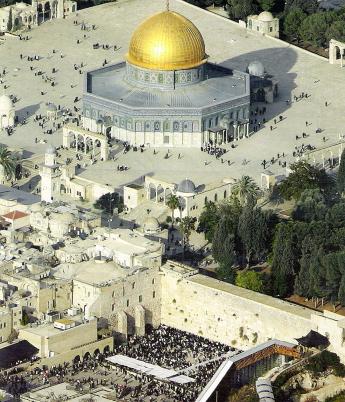
The heart of the Palestinian Arab argument at the time
was that the Western Wall was primarily a Muslim holy site. According to
Muslim traditions they claimed, it was where Muhammad tied his winged horse-,
on whom he had miraculously flown from Mecca to Jerusalem before ascending to
the heavens from the Temple Mount (see the wall below):
The
International Commission for the Wailing Wall, also known as the Shaw Commission,
was appointed by the British with League of Nations approval. It still
indicated that it preferred a voluntary solution to the controversy, but it
ultimately drafted a decision formally confirming Jewish rights of access to
the Western Wall. But, backing the British, it also accepted a highly
restrictive interpretation of what these rights entailed. For example, the
commission ruled that Jews could not bring benches or chairs to the Wall area,
and an ark containing Torah scrolls could only be brought on special holidays.
This reflected the commission's understanding of the status quo under the
Ottoman Empire. (Report of the Commission Appointed by His Majesty’s Government
in the United Kingdom of Great Britain and Northern Ireland, and with the
Approval of the Council of the League of Nations, to Determine the Rights and
Claims of Moslems and Jews in Connection with the western or Tyailing Tyall at Jerusalem , London: His Majesty's Stationery Office, 1931).
The
commission did not contest the Muslim claim to ownership over the Wall and the
pavement in front of it, but it utterly rejected the notion that al-Buraq was
tethered in the area where the Jews prayed, suggesting that this location was
further south. Hence it concluded, "Under these circumstances the
Commission does not consider that the Pavement in front of the Wall can be
regarded as a sacred place from a Moslem point of view.” It traced the Jewish
use of the site for prayer back to the fourth century CE, adding for further
corroboration the accounts of the Jewish traveler Benjamin of Tudela from 1167,
written before the area was declared waqf property. (Ibid.) These results were
totally unacceptable to the mufti and the Supreme Muslim Council, who now
rejected the legal competence of any international body except a Shariah court
to settle questions about Muslim holy sites. (Esco Foundation for Palestine,
Palestine: A Study of Jewish, Arab, and British Policies, Volume Two (New
Haven: Yale University Press, 1947, 614).
Husseini
then sought to further internationalize his struggle. The Supreme Muslim
Council authorized him to invite Arab and Muslim leaders to a World Islamic
Conference in Jerusalem slated for December 1931. When the conference opened
the attendance initially looked impressive-about 130
delegates from twenty-two countries. Important states were absent, though.
Turkey did not attend and even sought to subvert the conference, concerned that
it would become a forum for restoring the caliphate and undermining the secular
regime of Ataturk. The Saudi leader, King Abdul Aziz ibn Saud, diplomatically
explained that the invitation to the Jerusalem conference had arrived too late.
In all likelihood a Saudi decision had been taken to
boycott the whole event. (Y. Porath, The Palestinian Arab National Movement:
1929-1939 From Riots to Rebellion, London, 1977, 10).
Their
approach was colored by their experience in organizing the Congress of the Islamic
World in Mecca back in 1926. That conference had ended acrimoniously, with its
resolution to meet annually in Mecca coming to naught. Five years later, Ibn
Saud was not going to lend his weight to a Jerusalem conference that might
succeed where the Mecca conference had failed. Clearly, Husseini had not
convinced international Muslim leaders that Jews were threatening Islamic holy
sites. In fact, the purpose of the whole event was not entirely clear. Husseini
had stressed to invitees that the conference would
deal with the Buraq aI-Sharif. In his public call to
the conference, however, Shawkat Ali said nothing about the Buraq aI-Sharif, but rather spoke more generally about how
Muslims might defend their civilization
Husseini's
conference was convened on December 6, 1931, which corresponded on the Islamic
calendar to the day that Muhammad ascended to the heavens from the Temple Mount . At the opening of the conference, Husseini's
supporters resorted to their tried and true tactic of
disseminating doctored photos, this time showing Jews with machine guns
attacking the Dome of the Rock. The use of this transparent propaganda
alienated many delegates, who held a protest meeting at the King David Hotel
presided over by Husseini's Palestinian rival, Ragheb Bey al-Nashashibi, the
Jerusalem mayor. Husseini's congress sought to establish a permanent body that
would convene every two years. The executive committee
of the congress was headed by Husseini, thus giving him a pan-Islamic title and
platform for the first time. The congress also announced the need to establish
an Islamic university in Jerusalem, which apparently was not looked on
favorably by the religious leadership at al-Azhar in Egypt .
Adopting a resolution proclaiming the sanctity of the Buraq
al-Sharif, the congress rejected the report of the "Wailing Wall
Commission." Finally, it formally decided to deny Jews access to the
al-Aqsa Mosque, despite the fact that Jews had their
own religious reasons for staying away from the Temple Mount
. Notably, during these disputes over the Western Wall Husseini did not
adopt the tactic later embraced by Vasser Arafat of denying in total the
religious history of the Jews. For example, the Supreme Muslim Council, which
Husseini had headed since 1921, published an English-language book in 1924 for
visitors to the Temple Mount area titled A Brief Guide to al-Haram ai-Sharif
Jerusalem. The book's historical sketch of the site related that "the site
is one of the oldest in the world. Its sanctity dates from the earliest
(perhaps from pre-historic) times. Its identity with the site of Solomon's
Temple is beyond dispute." The 1930 edition remained unchanged despite the
1929 Western Wall riots. The Supreme Muslim Council did not engage in Temple Denial , as Arafat's generation would decades later.
Beginning in 1936, Jerusalem 's position in Palestinian politics was greatly
affected by what became known as the Arab Revolt, although the revolt did not
initially break out in Jerusalem. Husseini and the Arab Higher
Committee-another new body under his leadership-declared a nationwide strike.
In July 1937, the British finally cracked down on the mufti, who hid out on the
Temple Mount for three months. (Meron Benvenisti,
City of Stone: The Hidden History of Jerusalem,Berkley,
1996, 79).
The
area had become a hiding place for weapons and explosives by Palestinian Arabs.
In October 1937, Husseini fled British Palestine, first heading for Lebanon , then Iraq and finally Europe, where he met in
Berlin with Adolf Hitler during November 1941 and became a close ally of the
Nazi cause. (He would seek asylum after the war, fearing he would be prosecuted
as a war criminal.) In the meantime, back in 1937, the Palestinian strike
metastasized into an armed revolt, with volunteers arriving from neighboring
countries. Other leaders arose to lead the Palestinian Arabs' military
struggle. A major side effect of the 1936 Arab Revolt was that rural chieftains
in British Mandatory Palestine provided much of the revolt's leadership, Jerusalem , in fact, lost its pre-eminent place in
Palestinian politics. For example, of the 281 Arab officers involved, only ten
(or 3.5 percent) came from Jerusalem. (Michael C. Hudson, "The
Transformation of Jerusalem: 1917-1987 AD," in Kamil J. Asali, ed.,
Jerusalem in History: 3000 BC to the Present Day, 1997, 256).
Amin al-Husseini next became known for his meetings in
Berlin with Adolf Hitler. After discussions Grand Mufti and Hitler, the German
Africa Corps landed in Libya in February 1941, the critical phase for extending
the Holocaust to Palestine began.
On November 26, 1942, al-Husseini, cast from Berlin a
public radio speech in Arabic in what became a striking example of the
translation of Nazi propaganda into the idioms in the Arab world even today.” Jews and capitalists have pushed the United States
to expand this war, in order to expand their influence
in new and wealthy areas.- America is the greatest
agent of the Jews, and the Jews are rulers in America.”
Martin Cüppers and Klaus-Michael Mallmann, in their
study of 2006 "Halbmond und Hakenkreuz, on the
basis of countless examples, reject the research opinion that has prevailed up
to now which assumes irreconcilable ideological
differences between Arab Nationalists and National Socialists. The National
Socialists planned mass murder also of the Jews in Palestine in 1942. Mallmann
and Cüppers conclude that the only thing that
prevented a "German-Arab mass crime" against
the Jews was the defeat of the Germans in North Africa.
It
was noteworthy that prior to the adoption of the UN General Assembly resolution
in November 1947 calling for the partition of Palestine, the representatives of
the Palestinian Arabs did not make the issue of Jerusalem their primary focus.
Jama al- Husseini, the mufti's cousin, who presented the Palestinian Arab
position before the United Nations, still used pan-Arab motifs in making the
case of the Arab Higher Committee that he represented: "one consideration
of fundamental importance to the Arab world was that of racial
homogeneity." He explained that "the Arabs lived in a vast territory
stretching from the Mediterranean to the Indian Ocean, spoke one language, had
the same history, tradition, and aspirations." He referred to the threat of
an "alien body" entering the Middle East region. (Document 4:
"UN General Assembly Resolution 181 on the Future Government of
Palestine," Ruth Lapidoth and Moshe Hirsch, eds., The Jerusalem Question
and Its Resolution: Selected Documents, Martinus Nijhoff Publishers, 1994,
13-14).
In fact even
when Muslims retook Jerusalem in 1948, they quickly lost interest in it. In spite of 'Abdallah being crowned as "King of
Jerusalem", the Hashemites had little affection for Jerusalem. In fact,
the Hashemites made a concerted effort to diminish the holy city's importance
in favor of their capital, Amman. Jerusalem had served as the British
administrative capital, but now all government offices there (save tourism)
were shut down. The Jordanians also closed some local institutions (e.g., the
Arab Higher Committee) and moved others to Amman (the treasury of the
Palestinian waqf, or religious endowment).
Their effort succeeded. Once again,
Arab Jerusalem became an isolated provincial town, now even less important than
Nablus. The economy stagnated and many thousands left Arab Jerusalem. While the
population of Amman increased five-fold in the period 1948-67, Jerusalem's grew
just 50 percent. Amman was chosen as the site of the country's first university
as well as of the royal family's many residences. Perhaps most insulting of
all, Jordanian radio broadcast the Friday prayers not from al-Aqsa Mosque but
from a mosque in Amman.
Nor was Jordan alone in ignoring
Jerusalem; the city virtually disappeared from the Arab diplomatic map. No
foreign Arab leader came to Jerusalem between 1948 and 1967, and even King
Hussein visited only rarely. King Faisal of Saudi Arabia often spoke after 1967
of yearning to pray in Jerusalem, yet he appears never to have bothered to pray
there when he had the chance. Perhaps most remarkable is that the Palestinian
Liberation Organization's founding document, the Palestinian National Covenant
of 1964, does not even once mention Jerusalem.
All
this abruptly changed after June 1967, when the Old City came under Israeli
control. As in the British period, Palestinians again made Jerusalem the
centerpiece of their political program. Pictures of the Dome of the Rock turned
up everywhere, from Yasir Arafat's office to the corner grocery.
The April 1949 Armistice Agreement
As a result of the
First Arab-Israeli War, Jerusalem was divided, with
its Old City coming under the occupation of the Arab Legion of the Hashemite
Kingdom of ]ordan. Relations
between Israel and Jordan over Jerusalem were supposed to be governed by their
April 3, 1949, Armistice Agreement. According to Article VIII of the armistice,
both sides undertook to guarantee free access to Mt. Scopus as well as the
resumption of the "normal functioning" of its "cultural and
humanitarian institutions." The same article also assured "free
access to the Holy Places and cultural institutions and the use of the cemetery
on the Mount of Olives." If Article VIII had been implemented, Israelis
would have been able to visit the Old City of ]erusalem and pray at the Western Wall. The
Jordanians were to obtain road access to Bethlehem and the provision of Israeli
electricity to the Old City. To work out the modalities of these principles,
the same article called on both governments to appoint representatives to a
"Special Committee" that was supposed to formulate detailed plans.
True, there was a regular Israeli convoy to Mt. Scopus, but the Special
Committee was disbanded even before its meetings got under way, so that no
arrangements could be put in place for reopening Hebrew University or the
Hadassah Hospital . More significant, Israelis were
denied access to both the Western Wall and the Mount of Olives during the
entire period of Jordanian rule. Jordan further barred non-Israeli Jews from
the Western Wall, demanding that tourists present a certificate of baptism
before a visa would be granted. Formally, the Jordanians maintained that the
scope of the Special Committee needed to be broadened to include other holy
sites inside Israel such as those in Nazareth. (Tawfik al- Khalil, Jerusalem
from 1917 to 1967, Amman: Economic Press, 90-92).
The true motivation
behind Jordanian policy in these years was revealed in a frank exchange on
February 23, 1951, between Jordanian prime minister Samir al-'Rifa'i and an
Israeli envoy, Reuven Shiloah. Al-Rifa'i disclosed why his country had no
intention of implementing its armistice obligations under Article VIII-Jordan
simply had nothing to gain from the armistice any longer. Jordan no longer
needed access to the Bethlehem road from Israel-the
Jordanians had built another road instead-and the Old City would no longer need
Israeli electricity after Jordan worked out a different source of electrical
power. (Raphael Israeli, Jerusalem Divided: The Armistice Regime 1947-1967,
London, 2002, 58).
Noticing that the
British and U.S. ambassadors to Israel in 1954 were presenting their
credentials to the Israeli president in Jerusalem, one Palestinian writer
bemoaned that Israel had made Jerusalem into a capital while Jordan had reduced
it "from a position of preeminence to its Current place that does not rise
above rank of a village." (Kimberly Katz, Jordanian Jerusalem: Holy Places
and National Spaces, University Press of Florida, 2005, 85).
Christianity in
Jerusalem also suffered setbacks. Starting in 1953, the Jordanians decided that
Christian institutions would face restrictions in buying land in and around
Jerusalem. There were worldwide protests against the
Jordanian actions, leading the Jordanians to suspend the application of some of
these provisions. Nonetheless, according to one historical account, two years
later the British consul-general wrote a cable about an "anti-Christian
tendency" evident in Jordanian behavior. (Wasserstein, 193).
By
the 1960s Christian schools were told that they would have to close on Fridays
instead of Sundays, which had been their past practice. In this difficult
environment, the Christian population of Jerusalem declined from 25,000 in 1948
to 10,800 in 1967. (Address of Foreign Minister Abba Eban to the Knesset, June
30, 1971. See John M. Oesterreicher, "Jerusalem the Free," in
Oesterreicher and Sinai, 258)
It
would be erroneous to conclude however that during the period of its rule,
Jordan essentially cut itself off from Jerusalem; Jordan always sought to
invest in the area of the Temple Mount. Between 1952
and 1959, the Jordanians undertook a new restoration project at the Dome of the
Rock. The U.S. began to receive reports in 1960 that Jordan planned to treat
Jerusalem as a second capital. (Document 31, "Aide Memoire Delivered by
the United States Department of State to the Prime Minister of Jordan Concerning
the Intention of Jordan to Treat the City of Jerusalem as Its Second Capital, 5
April 1960," in Lapidoth and Hirsch, 160).
During
the period of Jordanian rule, another political body would come to influence
the struggle for Jerusalem: the Palestine Liberation Organization (PLO). It was
founded in May 1964 by a conference of four, hundred delegates meeting at the
Intercontinental Hotel in Jordanian-controlled Jerusalem. Its first head, Ahmad
Shukeiry, was a Palestinian who served as a Saudi Arabian diplomat until he
fell out with the Saudi leadership. The early PLO was completely controlled by
Egypt, which sponsored the proposal for its creation at an Arab Summit meeting in order to reduce the relative responsibility of the Arab
states to resolve the Palestinian issue. The PLO covenant rejected Jewish
claims to Palestine and the validity of the League of Nations mandate. But it
did not specifically single out Palestinian claims to Jerusalem, which are not
even mentioned in the covenant-either in its original version promulgated in
1964 or in its 1968 rendition. (Wasserstein noted that there was no mention of
Jerusalem either in its ten-point political statement issued in Cairo on June
8,1974). The early PLO had good reasons to leave Jerusalem out of its founding
charter. It did not want to antagonize its Jordanian hosts.
Enter Arafat:

For a
short period of four years in the mid-1930s, Arafat's widowed father sent him
from Cairo to Jerusalem to live with his mother's family. He was a child
volunteer to one of the assistants to the mufti, who became for Arafat a figure
to be emulated. In order to sustain the legend that he
promoted about his past, Arafat would argue that he fought in the First Arab-Israeli War under Abdul Qader al-Husseini, who was both
the mufti's cousin and one of the main Palestinian commanders who died in the
battle for Jerusalem. Arafat did fight in the 1948 war, but not with the
Palestinians as he maintained. Instead, he was recruited into the Egyptian tmits that were organized by the Muslim Brotherhood in
Cairo. (M. Shemesh, The Palestinian Entity 1959-1974: Arab Politics and the
PLO, London, 1996).
Even
after Arafat's takeover of the PLO, certain aspects of the organization's
unique approach to the Jerusalem question only became evident many years later.
Arafat's real political constituency that sustained him in power over the years
was located in the Palestinian refugee camps, first on
the East Bank in Jordan, and then in Lebanon. The Palestinian elites in East
Jerusalem were not part of that constituency and even presented a potential
alternative leadership, at times, to Arafat's organization, which was based far
away in Lebanon and later in Tunisia. Due to the PLO's refusal for several
decades formally to renounce terrorism or meet any of the minimal
pre-conditions that the U.S. set for a diplomatic dialogue, the East Jerusalem
leadership would be able to meet U.S. secretaries of state, while Arafat could
not even see a U.S. ambassador.
Because
Arafat had a different political constituency, he was willing to agree to
tactical concessions in Jerusalem that were unacceptable to the local
leadership. In fact, looking ahead a number of decades, one of the reason that
Israeli prime minister Yitzhak Rabin was willing to pursue a secret negotiating
track with the PLO in Oslo-which eventually led to the signing of the
Declaration of Principles in 1993 on the White House lawn-was precisely because
the PLO was willing to exclude Jerusalem from any interim self-governing
arrangements for the Palestinians.
Indeed, while Jerusalem played a central role in Yasser Arafat's rhetoric, he
was willing to set the Holy City aside, when pressed in negotiations, in the
years that followed.
By
then of course, the 1967 Six-Day War had revolutionized the situation of
Jerusalem by bringing about its reunification after nineteen years. Moreover,
the specific conditions out of which the conflict erupted created new legal
rights and diplomatic terms of reference that would replace the armistice
agreements of 1949; for the armistice agreements had patently failed, and
something new was needed in their stead. But the immediate causes of the war
were related to developments on other fronts. Military tensions along the Israeli-Syrian front rose steadily from April 1967,
provoking the Soviet Union deliberately to mislead Egypt into believing that an
Israeli strike on Syria was imminent.
As a
result, the Egyptian regime under President Gamal Abd aI-Nasser
took three critical steps that led inevitably to war. First, Nasser massed
80,000 troops in Egyptian Sinai along Israel 's southern Negev border. Next, to
give credibility to his threat, the Egyptian president demanded that the UN
Emergency Force that had been deployed for a decade along that sensitive border
zone withdraw-and UN secretary-general U Thant complied. Finally, Nasser
announced a naval blockade of Israel's southern port of Eilat. All shipping
between the port and the Red Sea and Indian Ocean was thus threatened by
artillery positions Egypt had emplaced adjacent to the narrow Straits ofTiran, near the tip of the Sinai
peninsula. The Egyptian president's military buildup had taken on a
momentum of its own. He announced his intentions on May 26, 1967: "The
battle will be a general one and our basic objective will be to destroy
Israel." (Document 39, "Nasser's Speech to Arab Trade
Unionists," May 26,1967, Walter Laqueur and Barry Rubin, eds., The Israeli-Arab Reader: A Documentary History of the Middle
East Conflict, New York: Penguin Books, 1984, 176).
But Internationalization
had already patently failed back in 1948; the UN hadn't lifted a finger to
break the siege of Jerusalem, leading Prime Minister Ben-Gurion to declare in
1949 that the elements in Resolution 181 that related to Jerusalem were
"null and void." Now the EU was resurrecting a superannuated UN
General Assembly resolution that had been utterly rejected by the Arab side in
1947 and had been abandoned afterwards by the Israelis after they had waged a
bitter war, with no international help, in Jerusalem's defense. In any case, it
had not been a legally binding international agreement, but only a failed
recommendation of the UN. The newly articulated EU position only radicalized
the Palestinians.
The
official Palestinian Authority newspaper al-Ayyam quoted on March 14, 1999, the
conclusion of the leading Palestinian negotiator, Abu Ala': "The [EU's]
letter asserts that Jerusalem in both its parts-the Western and the Eastern-is
a land under occupation." It should be stressed that Abu Ala' was thought
by most Israelis to be pragmatic; he was the senior PLO official in the Oslo
back channel that led to the Oslo Agreement. Yet even his position had
hardened. Just over one year before Camp David, Arafat emerged from a meeting
with UN secretary-general Kofi Annan and spoke to reporters in Arabic about
Resolution 181. On March 25, his representative to the UN, Nasser al-Kidwa, then wrote a letter to Annan that was released as a
UN document in which he argued that the old partition boundaries from
Resolution 181 were what the international community had accepted. This
argument not only could be used to refute Israel 's claims to East Jerusalem,
but could egually be applied to West Jerusalem as
well. Meir Ben-Dov, Historical Atlas of Jerusalem, New York: 2002 , 214).
In
fact Yasser Abd Rabbo, the Palestinian Authority minister of information,
confessed on a television program broadcast on November 17, 2000 on the
Qatar-based al-Jazeera network that there
was "a consensus among Palestinians that the direct goal is to reach
the establishment of an independent Palestinian state in the June 4, 1967,
borders, with Jerusalem as its capital, [but] regarding to the future after
that, it is best to leave the issue aside and not to discuss it."
Thus
despite the unprecedented concessions offered by Barak regarding Jerusalem , especially in comparison with every preceding
Israeli prime minister since 1967, the PLO did not offer any corresponding
readiness to compromise on territorial matters. Arafat in essence insisted on
receiving 100 percent of the West Bank, including East Jerusalem, and the Gaza
Strip. He was only willing to concede land in these territories if he received
equivalent compensation via a land swap from unpopulated territories inside of
pre-1967 Israel like the arid Halutza area of the
Negev. This in spite of the fact that Resolution 242
from November 1967, which had served until Camp David as the basis of Israeli -
Palestinian agreements, did not articulate any need for a land swap.
In fact Faisal al-Husseini was far more revealing about the
PLO's ultimate intentions during the Oslo years. He compared Arafat's use of
the Oslo peace process to a Trojan horse that allowed the PLO to get the
Israelis to open "their fortified gates and let it inside their
walls." The real strategic goal of the PLO, he explained, had been a
Palestine "from the [Jordan] River to the [Mediterranean] Sea," and
not a mini-state in the West Bank. (Donald Little,
"Jerusalem under the Ayyubids and the Mamluks: 1187-1516 AD,180).
Salim
Za'anun, the chairman of the Palestine National Council, stated in an official
PA newspaper that the PLO covenant calling for Israel's destruction had never
changed and hence remained in force. To give these words added authority, they
were written up in the official Palestinian Authority newspaper al-Hayat al-Jadida on January 1, 2001.
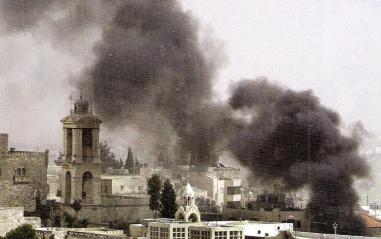
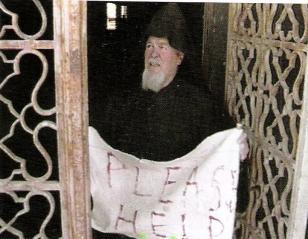
Black smoke came out of Bethlehem's Manger Square,
next to the Church of the Nativity, where on April 2, 2002, a joint Hamas-
Fatah Tanzim force of thirteen ('terrorists') held the clergy as hostages for
thirty-nine days:
In fact also according to shi'ite echatology according to the President of Iran Ahmadinejad,
the destruction of Israel is one of the key global developments that will
trigger the appearance of the Mahdi the 12th Imam of Meshad. In his first UN
General Assembly address, Ahmadinejad closed with a prayer that the Mahdi's
arrival be quickened: "Oh mighty Lord, I pray to you to hasten the
emergence of your last repository, the promised one." Dr. Bilal Na'im
assistant to the head of the Executive Council of Hizballah, discussing the
details of how the Mahdi is supposed to appear before the world, writes that
initially the Mahdi reveals himself in Mecca "and he will lean on the Ka'abah and view the arrival of his supporters from around
the world."
From
Mecca the Mahdi next moves to Karbala in Iraq. But his most important
destination, in Na'im's description, is clearly Jerusalem. It is in Jerusalem
from where the launching of the Mahdi's world conquest is declared. He
explains, "The liberation of Jerusalem is the preface for liberating the
world and establishing the state of justice and values on earth." (Search
for Common Ground in the Middle East, Program Update 2006).
As I
explained at the start of this website, there is a common misperception that
preoccupation with the coming of the Mahdi occurred only in the world of
Shiism; but in fact, Sunni Islam has generated a number of figures who claimed
to be the Mahdi, including the famous Mahdi of Sudan who fought General Gordon
and the British in the 1880s, and most recently Muhammad al-Qahtani, who with
his brother-in-law, Juhaiman al- Utaibi
took over the Grand Mosque in Mecca in 1979.
Even
those who downplay the influence of Islamic apocalyptic literature on the
public at large admit that it has a strong following among Islamic radicals.
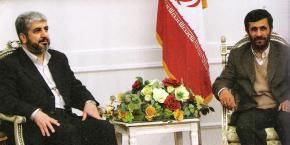
Hamas
is the Palestinian branch of the Muslim Brotherhood, a radical Sunni
organization that gave birth to many jihadist groups. Without forfeiting its
ties to militant Sunni networks Khaled Mashaal (left), the Damascus-based Hamas
leader, meets with Iranian president Mahmoud Ahmadinejad (right) in Tehran on
February 20, 2006:
During the years of
Oslo, Jordan lost much of its influence over the administration of Islamic
affairs on the Temple Mount to the Palestinian Authority, but it has been
seeking to recover it as of late. (Jerusalem Post, October 11, 2006, Edgar
Lefkovits, "Jordan Plans New Temple Mt. Minaret," Jerusalem Post,
October 11, 2006). In fact one could wonder if Arab
states like Saudi Arabia would do better, by supporting the moderate role
of Jordan in these administrative issues today. No state should have an interest
in radical Islamic sermons in the al-Aqsa Mosque calling for the overthrow of
various UN recognized countries that include in fact, Arab regimes.
Palestinian
nationalism’s first enemy is Israel, but if Israel ceased to exist, the
question of an independent Palestinian state would not be settled. All of the countries bordering such a state would have
serious claims on its lands, not to mention a profound distrust of Palestinian
intentions. The end of Israel thus would not guarantee a Palestinian state. One
of the remarkable things about Israel’s Operation Cast Lead in Gaza was that no
Arab state moved quickly to take aggressive steps on the Gazans’ behalf. Apart from
ritual condemnation, weeks into the offensive no Arab state had done anything
significant. This was not accidental: The Arab states do not view the creation
of a Palestinian state as being in their interests. They do view the
destruction of Israel as being in their interests, but since they do not expect
that to come about anytime soon, it is in their interest to reach some sort of
understanding with the Israelis while keeping the Palestinians contained.
The
emergence of a Palestinian state in the context of an Israeli state also is not
something the Arab regimes see as in their interest — and this is not a new
phenomenon. They have never simply acknowledged Palestinian rights beyond the
destruction of Israel. In theory, they have backed the Palestinian cause, but
in practice they have ranged from indifferent to hostile toward it. Indeed, the
major power that is now attempting to act on behalf of the Palestinians is Iran
— a non-Arab state whose involvement is regarded by the Arab regimes as one
more reason to distrust the Palestinians.
Therefore,
when we say that Palestinian nationalism was born in battle, we do not mean
simply that it was born in the conflict with Israel: Palestinian nationalism
also was formed in conflict with the Arab world, which has both sustained the
Palestinians and abandoned them. Even when the Arab states have gone to war
with Israel, as in 1973, they have fought for their own national interests —
and for the destruction of Israel — but not for the creation of a Palestinian
state. And when the Palestinians were in battle against the Israelis, the Arab
regimes’ responses ranged from indifferent to hostile.
The
Palestinians are trapped in regional geopolitics. They also are trapped in
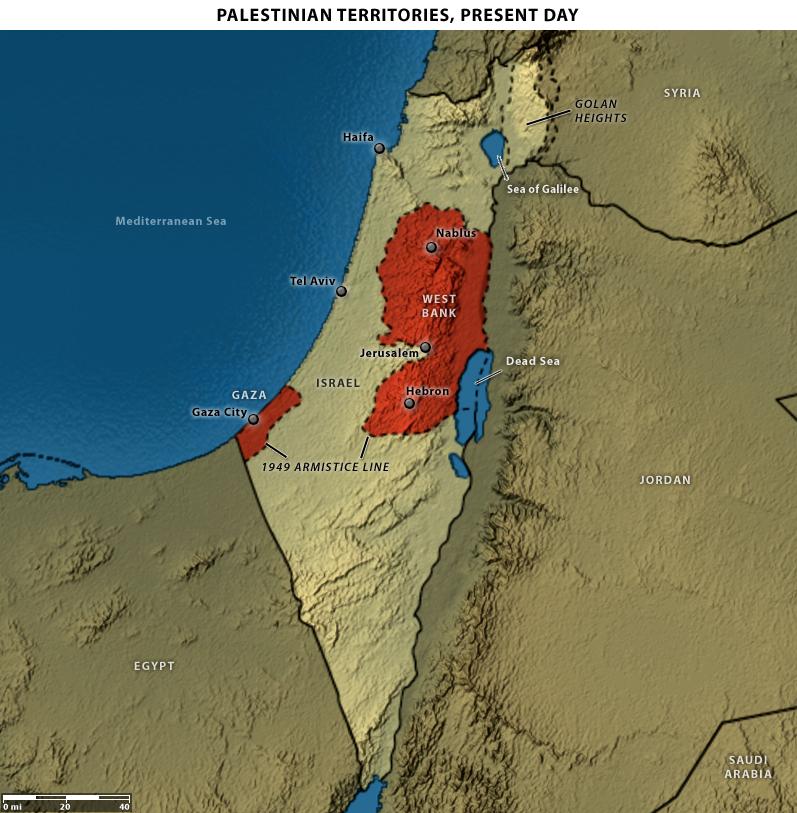
their own particular geography. First, and most
obviously, their territory is divided into two widely separated
states: the Gaza Strip and the West Bank. Second, these two places are very
different from each other. Gaza is a nightmare into which Palestinians fleeing
Israel were forced by the Egyptians. It is a social and economic trap. The West
Bank is less unbearable, but regardless of what happens to Jewish settlements,
it is trapped between two enemies, Israel and Jordan. Economically, it can
exist only in dependency on its more dynamic neighboring economy, which means
Israel.
Gaza
has the military advantage of being dense and urbanized. It can be defended.
But it is an economic catastrophe, and given its demographics, the only way out
of its condition is to export workers to Israel. To a lesser extent, the same
is true for the West Bank. And the Palestinians have been exporting workers for
generations. They have immigrated to countries in the region and around the
world. Any peace agreement with Israel would increase the exportation of labor
locally, with Palestinian labor moving into the Israeli market. Therefore, the
paradox is that while the current situation allows a degree of autonomy amid
social, economic and military catastrophe, a settlement would dramatically
undermine Palestinian autonomy by creating Palestinian dependence on Israel.
The
only solution for the Palestinians to this conundrum is the destruction of
Israel. But they lack the ability to destroy Israel. The destruction of Israel
represents a far-fetched scenario, but were it to happen, it would necessitate
that other nations hostile to Israel — both bordering the Jewish state and
elsewhere in the region — play a major role. And if they did play this role,
there is nothing in their history, ideology or position that indicates they
would find the creation of a Palestinian state in their interests. Each would
have very different ideas of what to do in the event of Israel’s destruction.
Therefore,
the Palestinians are trapped four ways. First, they are trapped by the
Israelis. Second, they are trapped by the Arab regimes. Third, they are trapped
by geography, which makes any settlement a preface to dependency. Finally, they
are trapped in the reality in which they exist, which rotates from the
minimally bearable to the unbearable. Their choices are to give up autonomy and
nationalism in favor of economic dependency, or retain autonomy and nationalism
expressed through the only means they have — wars that they can at best survive, but can never win.
The
present division between Gaza and the West Bank had its origins in the British
mandate. Palestine was partitioned between Jews and Arabs. In the wake of the
1948 War, Arabs lost control of what was Israel; the borders that emerged from
this war and lasted until 1967 are still recognized as Israel’s international
boundary. The area called the West Bank was part of Jordan. The area called
Gaza was effectively under Egyptian control. Numbers of Arabs remained in
Israel as Israeli citizens, and played only a marginal
role in Palestinian affairs thereafter.
During
the 1967 Arab-Israeli war, Israel occupied both Gaza
and the West Bank, taking direct military and administrative control of both
regions. The political apparatus of the Palestinians, organized around the PLO
— an umbrella organization of diverse Palestinian groups — operated outside
these areas, first in Jordan, then in Lebanon after 1970, and then in Tunisia
after the 1982 invasion of Lebanon by Israel. The PLO and its constituent parts maintained control of groups resisting Israeli
occupation in these two areas.
The
idea of an independent Palestinian state, since 1967, has been geographically
focused on these two areas. The concept has been that, following mutual
recognition between Israel and the Palestinians, Palestine would be established
as a nation-state based in Gaza and the West Bank. The question of the status
of Jerusalem was always a vital symbolic issue for both sides, but it did not
fundamentally affect the geopolitical reality.
Gaza
and the West Bank are physically separated. Any axis would require that Israel
permit land or air transit between them. This is obviously an inherently
unstable situation, although not an impossible one. A negative example would be
Pakistan during the 1947-1971 period, with its eastern and western wings
separated by India. This situation ultimately led to the 1971 separation of
these two territories into two states, Pakistan and Bangladesh. On the other
hand, Alaska is separate from the rest of the United States, which has not been
a hindrance. The difference is obvious. Pakistan and Bangladesh were separated
by India, a powerful and hostile state. Alaska and the rest of the United
States were separated by Canada, a much weaker and less hostile state.
Following this analogy, the situation between Israel and the hypothetical
Palestine resembles the Indo-Pakistani equation far more than it does the
U.S.-Canadian equation.
The
separation between the two Palestinian regions imposes an inevitable
regionalism on the Palestinian state. Gaza and the West Bank are very different
places. Gaza is about 25 miles long and no more than 7.5 miles at its greatest
width, with a total area of about 146 square miles. According to 2008 figures,
more than 1.5 million Palestinians live there, giving it a population density
of about 11,060 per square mile, roughly that of a city. Gaza is, in fact,
better thought of as a city than a region. And like a city, its primary
economic activity should be commerce or manufacturing, but neither is possible
given the active hostility of Israel and Egypt. The West Bank, on the other
hand, has a population density of a little over 600 people per square mile,
many living in discrete urban areas distributed through rural areas.
In
other words, the West Bank and Gaza are entirely different universes with
completely different dynamics. Gaza is a compact city incapable of supporting
itself in its current circumstances and overwhelmingly dependent on outside
aid; the West Bank has a much higher degree of self-sufficiency, even in its
current situation. Under the best of circumstances, Gaza will be entirely
dependent on external economic relations. In the worst of circumstances, it
will be entirely dependent on outside aid. The West Bank would be neither. Were
Gaza physically part of the West Bank, it would be the latter’s largest city,
making Palestine a more complex nation-state. As it is, the dynamic
of the two regions is entirely different.
Gaza’s
situation is one of pure dependency amid hostility. It has much less to lose
than the West Bank and far less room for maneuver. It
also must tend toward a more uniform response to events. Where the West Bank
did not uniformly participate in the intifada — towns like Hebron were hotbeds
of conflict while Jericho remained relatively peaceful — the sheer compactness
of Gaza forces everyone into the same cauldron. And just as Gaza has no room
for maneuver, neither do individuals. That leaves little nuance in Gaza
compared to the West Bank, and compels a more radical
approach than is generated in the West Bank.
If a
Palestinian state were created, it is not clear that the dynamics of Gaza, the
city-state, and the West Bank, more of a nation-state, would be compatible.
Under the best of circumstances, Gaza could not survive at its current size
without a rapid economic evolution that would generate revenue from trade,
banking and other activities common in successful Mediterranean cities. But
these cities have either much smaller populations or much larger areas
supported by surrounding territory. It is not clear how Gaza could get from
where it is to where it would need to be to attain viability.
Therefore,
one of the immediate consequences of independence would be a massive outflow of
Gazans to the West Bank. The economic conditions of the West Bank are better,
but a massive inflow of hundreds of thousands of Gazans, for whom anything is
better than what they had in Gaza, would buckle the West Bank economy. Tensions
currently visible between the West Bank under Fatah and Gaza under Hamas would
intensify. The West Bank could not absorb the population flow from Gaza, but
the Gazans could not remain in Gaza except in virtually total dependence on
foreign aid.
The
only conceivable solution to the economic issue would be for Palestinians to
seek work en masse in more dynamic economies. This would mean either emigration
or entering the work force in Egypt, Jordan, Syria or Israel. Egypt has its own
serious economic troubles, and Syria and Jordan are both too small to solve
this problem — and that is completely apart from the political issues that
would arise after such immigration. Therefore, the only economy that could
employ surplus Palestinian labor is Israel’s.
Security
concerns apart, while the Israeli economy might be able to metabolize this
labor, it would turn an independent Palestinian state into an Israeli economic
dependency. The ability of the Israelis to control labor flows has always been
one means for controlling Palestinian behavior. To move even more deeply into
this relationship would mean an effective annulment of Palestinian
independence. The degree to which Palestine would depend on Israeli labor
markets would turn Palestine into an extension of the Israeli economy. And the
driver of this will not be the West Bank, which might be able to create a
viable economy over time, but Gaza, which cannot.
From
this economic analysis flows the logic of Gaza’s Hamas. Accepting a Palestinian
state along lines even approximating the 1948 partition, regardless of the
status of Jerusalem, would not result in an independent Palestinian state in
anything but name. Particularly for Gaza, it would solve nothing. Thus, the
Palestinian desire to destroy Israel flows not only from ideology and/or
religion, but from a rational analysis of what independence within the current
geographical architecture would mean: a divided nation with profoundly
different interests, one part utterly incapable of self-sufficiency, the other
part potentially capable of it — but only if it jettisons responsibility for
Gaza.
It
follows that support for a two-state solution will be found most strongly in
the West Bank and not at all in Gaza. But in truth, the two-state solution is
not a solution to Palestinian desires for a state, since that state would be
independent in name only. At the same time, the destruction of Israel is an
impossibility so long as Israel is strong and other Arab states are hostile to
Palestinians.
Palestine
cannot survive in a two-state solution. It therefore must seek a more radical
outcome — the elimination of Israel — that it cannot possibly achieve by
itself. The Palestinian state is thus an entity that has not fulfilled any of
its geopolitical imperatives and which does not have a direct line to achieve
them. What an independent Palestinian state would need in
order to survive is:
· The
recreation of the state of hostilities that existed prior to Camp David between
Egypt and Israel. Until Egypt is strong and hostile to Israel, there is no hope
for the Palestinians.
· The
overthrow of the Hashemite government of Jordan, and the movement of troops
hostile to Israel to the Jordan River line.
· A
major global power prepared to underwrite the military capabilities of Egypt
and those of whatever eastern power moves into Jordan (Iraq, Iran, Turkey or a
coalition of the foregoing).
· A
shift in the correlation of forces between Israel and its immediate neighbors,
which ultimately would result in the collapse of the Israeli state.
Note that what the Palestinians require is in direct opposition to the
interests of Egypt and Jordan — and to those of much of the rest of the Arab
world, which would not welcome Iran or Turkey deploying forces in their
heartland. It would also require a global shift that would create a global
power able to challenge the United States and motivated to arm the new regimes.
In any scenario, however, the success of Palestinian statehood remains utterly
dependent upon outside events somehow working to the Palestinians’ advantage.
The
Palestinians have always been a threat to other Arab states because the means
for achieving their national aspiration require significant risk-taking by
other states. Without that appetite for risk, the Palestinians are stranded.
Therefore, Palestinian policy always has been to try to manipulate the policies
of other Arab states, or failing that, to undermine and replace those states.
This divergence of interest between the Palestinians and existing Arab states
always has been the Achilles’ heel of Palestinian nationalism. The Palestinians
must defeat Israel to have a state, and to achieve that they must have other
Arab states willing to undertake the primary burden of defeating Israel. This
has not been in the interests of other Arab states, and therefore the
Palestinians have persistently worked against them, as we see again in the case
of Egypt.
Paradoxically,
while the ultimate enemy of Palestine is Israel, the immediate enemy is always
other Arab countries. For there to be a Palestine, there must be a sea change
not only in the region, but in the global power configuration and in Israel’s
strategic strength. The Palestinians can neither live with a two-state
solution, nor achieve the destruction of Israel.
For updates
click homepage here