By Eric Vandenbroeck and co-workers
Nazi's and
Nobles in Germany
Part One of
Two
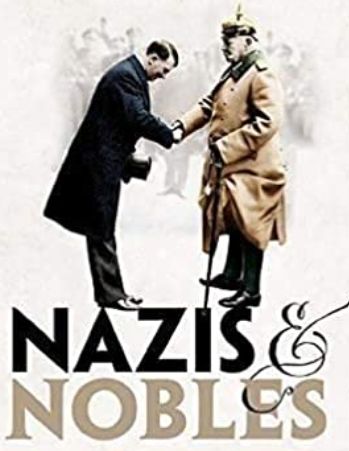
Operation Valkyrie (German: Unternehmen Walküre) was a German World War II emergency continuity of
government operations plan. Claus von Stauffenberg
modified the plan to use it to take control of German cities, disarm the SS,
and arrest the Nazi leadership once Hitler had been assassinated in the 20 July
plot. It is generally accepted by historians today that the ”July 20 plotters”
depicted in Valkyrie; believed in revolution from above. Or, as Hans
Mommsen elaborated, their "plans for a new order relied extensively on
neoconservative and corporatist ideas of the Weimar period, in particular going
back to Spengler's model of a 'Prussian socialism.' For a number of the
conspirators ... the Prussian tradition represented a central motive for the
decision to join the resistance."1
Besides Staufenberg, among the prominent
conspirators were the following members of the nobility: Count Ewald von
Kleist-Schmenzin (1890-1945), Werner von Haeften (1908-44), Albrecht Ritter Merz von Quirnheim (1905-44), Erwin von Witzleben (1881-1944), Adam von Trott zu Solz (1909-44),
Ulrich von Hassell (1881-1944), Henning von Tresckow (1901-44),
Count Helmuth James von Moltke (1907-45), Count Wolf-Heinrich von Helldorf (1896-1944), Count Friedrich Werner von der
Schulenburg (1875-1944), and Count Peter Yorck von Wartenburg (1904-44).2 Whereby most of the
former are, not mentioned in Valkyrie are; Prince Louis Ferdinand von
Preussen; who exhibited a willingness to lend his support; and Crown Prince
Wilhelm's former adjutant, Count Heinrich Dohna-Schlobitten (1882-1944)
who was hanged for it.3
But as already suggested, the public image of the German aristocracy
during the Nazi period to date, have indeed been largely shaped by the
well-known events depicted in Valkyrie. This became especially visible in
context of the sixtieth anniversary of the assassination attempt, following
which it has frequently been pointed out how strongly aristocrats themselves
were committed (and has been ever since 1945)-- to stressing the aristocratic
resistance to National Socialism. This has produced a view today in which the history
of the aristocracy under Nazism is practically identified with that of the
resistance. That is until shortly after a 2003 when a major academic work by
Stephan Malinowski came out, in which for the first time-- the real
relationship between the aristocracy and National Socialism was examined.4
What emerged from Malinowski ‘s 660 pages in depth research, is that
indeed large sections of the German aristocracy, became radically right wing
after 1918 . Among others, on p. 570 of his book, Malinowski pointed out
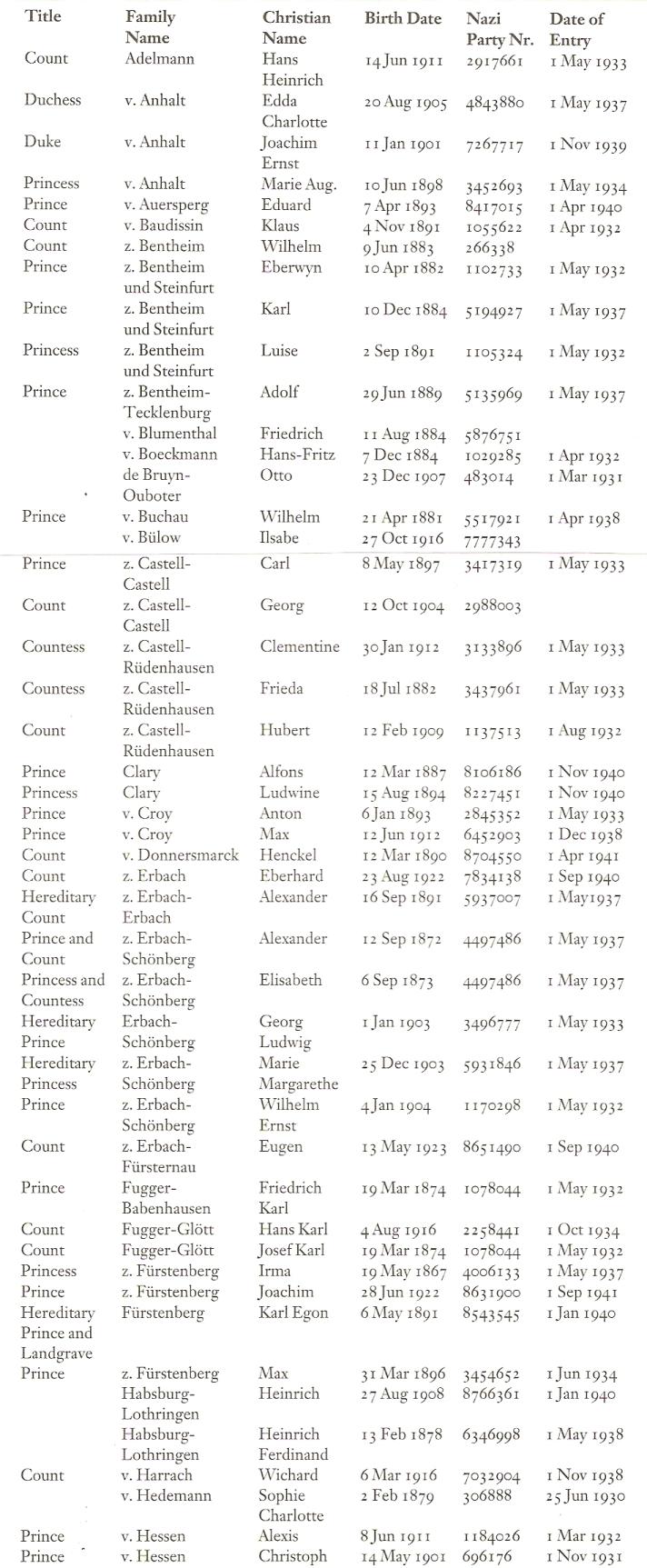
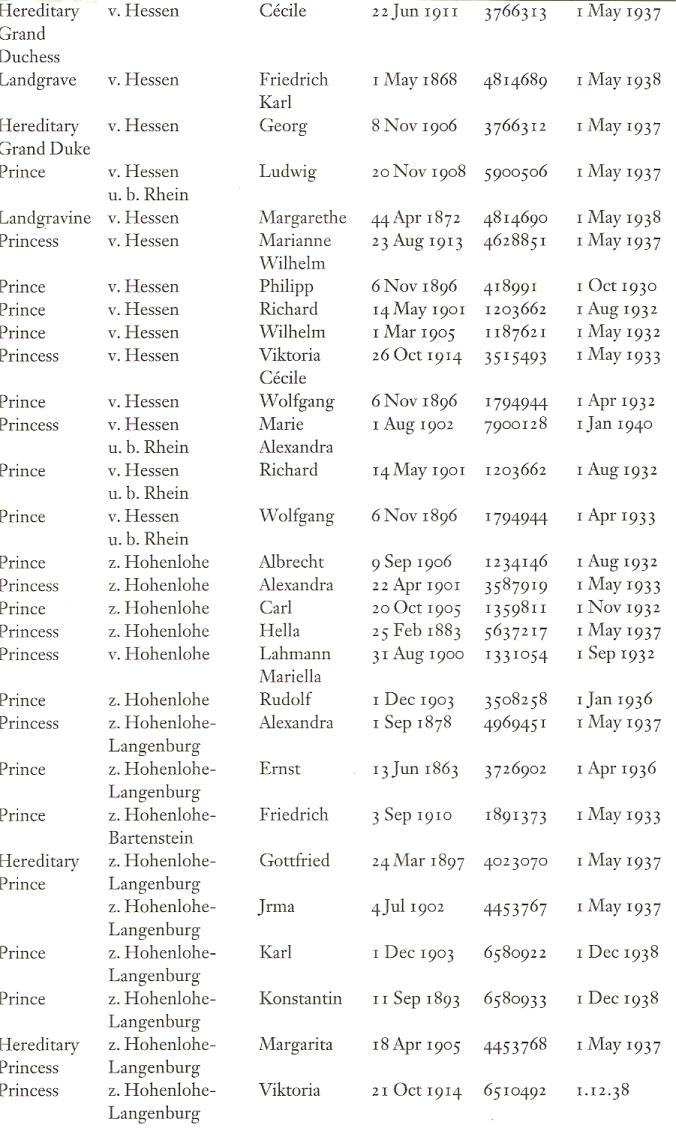
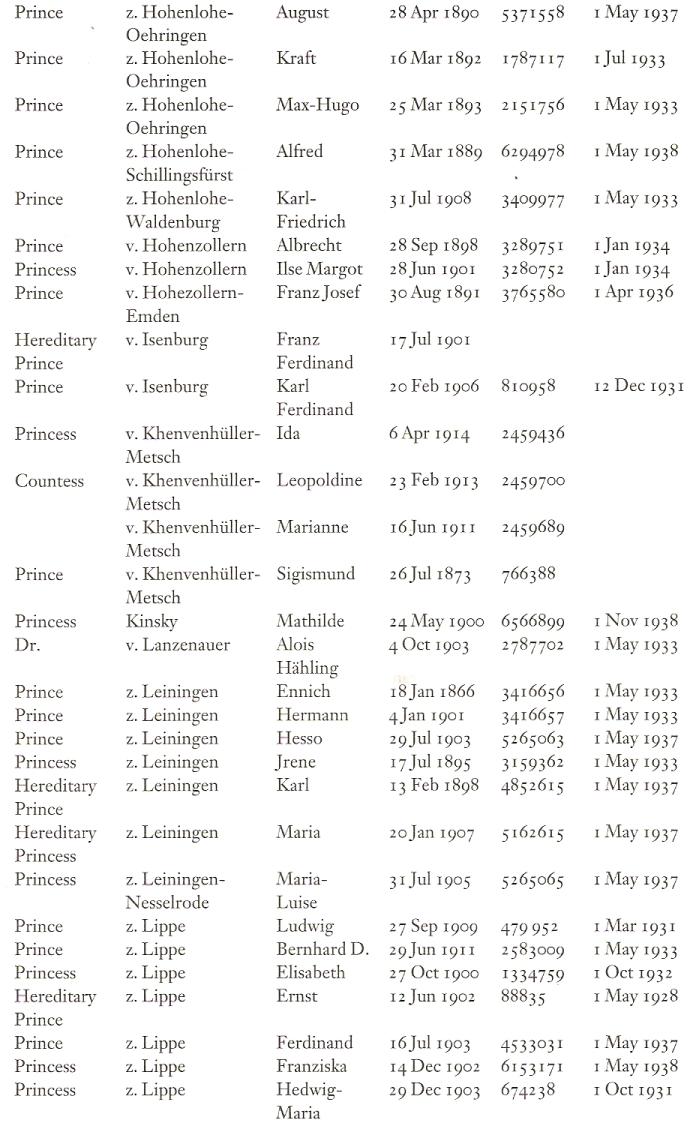
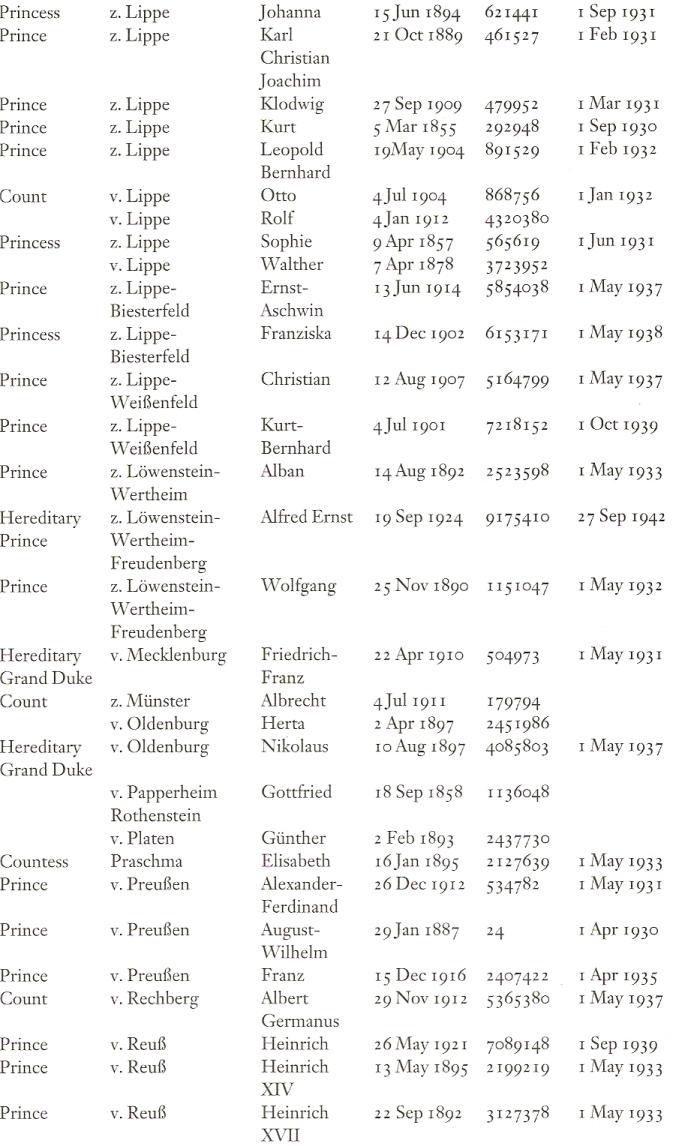
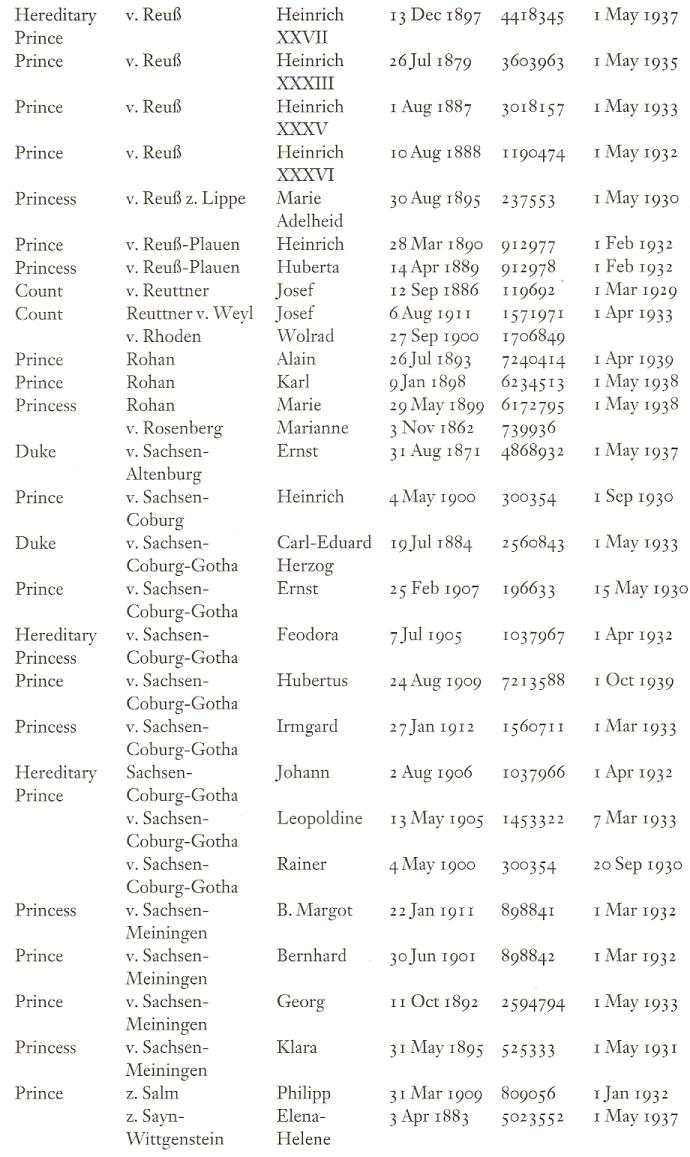
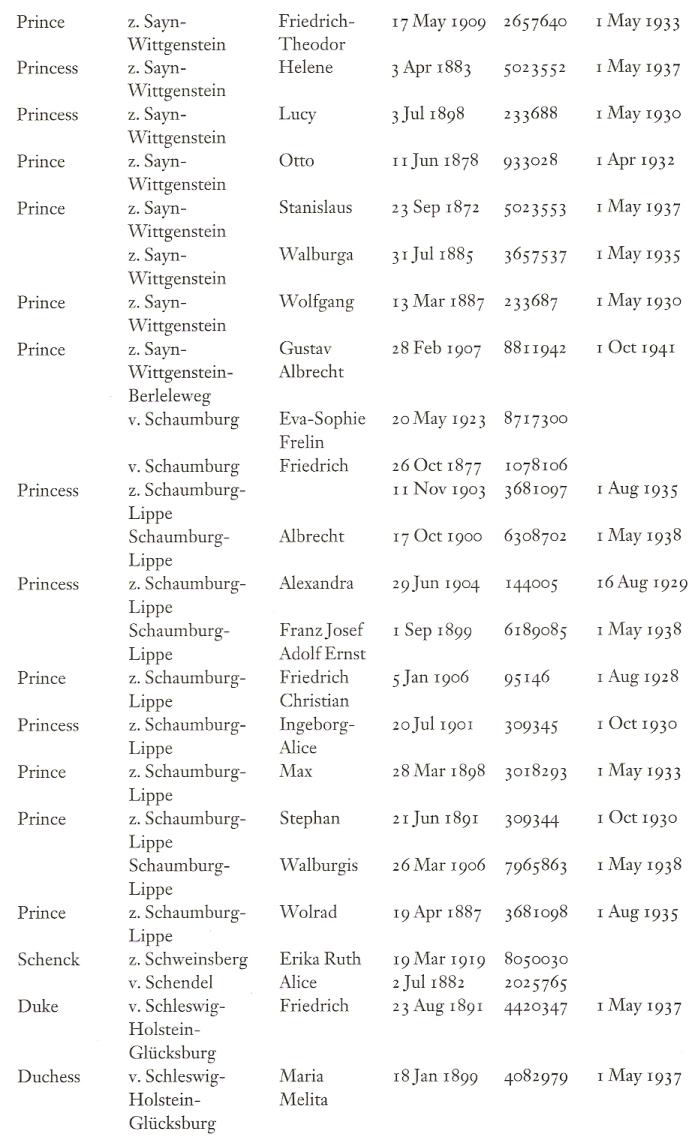
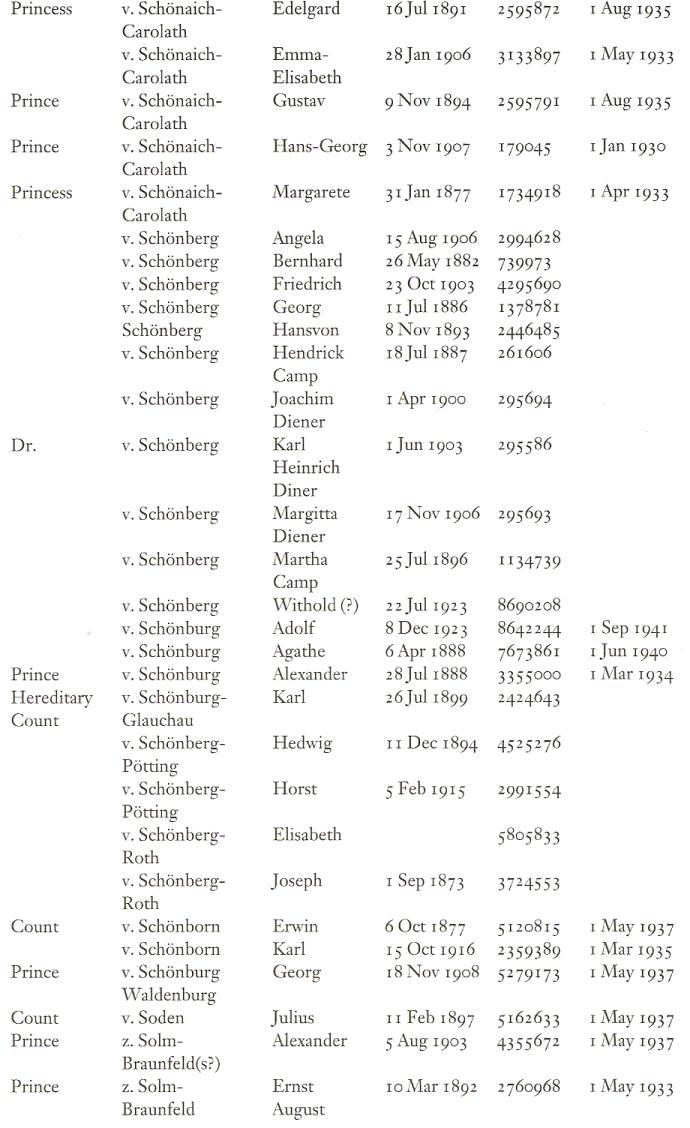
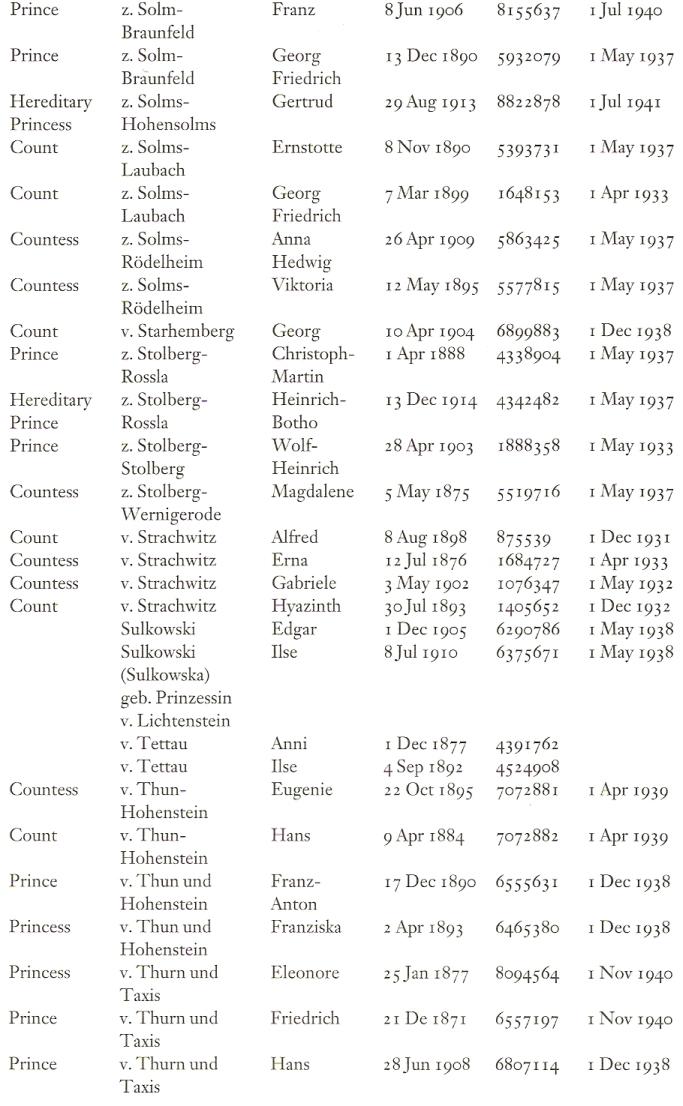
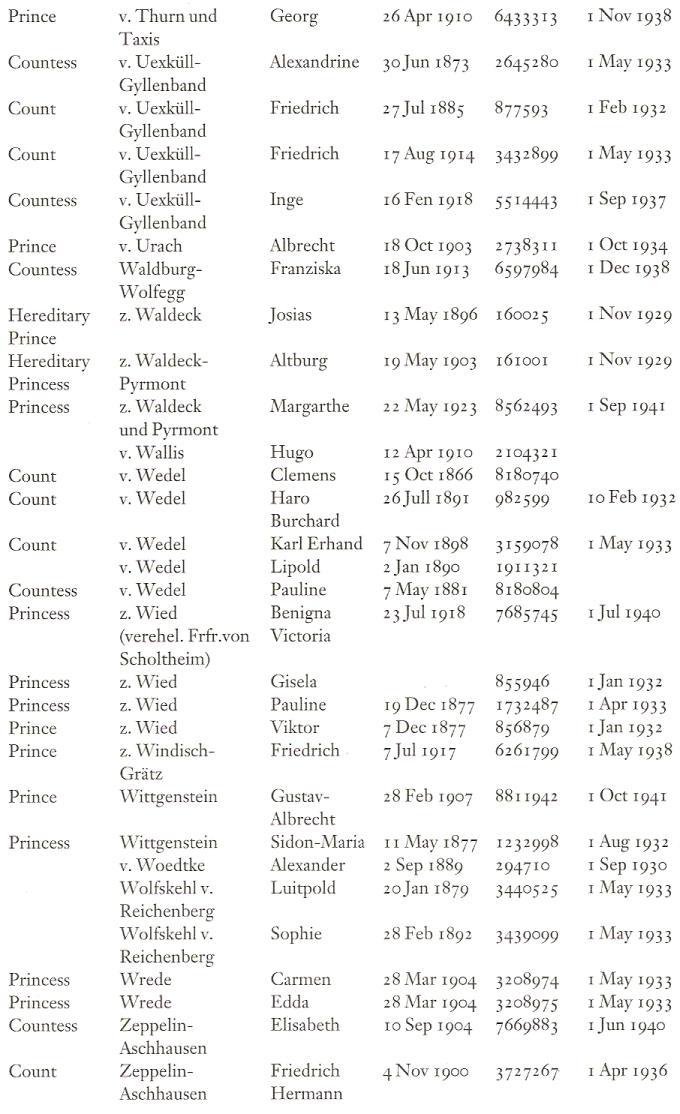
that the Nazis kept very good records— one document in the German Federal
Archives contains a list of no less than 270 members of princely families who
had joined the Nazi Party. While it was difficult to provide an exact
percentage, it appeared that about a third of the princes eligible to do so had
joined the NSDAP. For the first time ever, published on the internet
(Nov.30,2007), underneath the footnotes, you can see the complete list from
the Bundesarchiv Berlin-Lichterfelde. (Sammlung Schumacher, R. 187/400, "Aufstellung
derjenigen Parteigenossen, die Angehoerige fuerstlicher Hauser sind.")
Thus among others, in 1938, 18.7 percent of the lieutenant generals (Obergruppenfuhrer); 9.8 percent of the major generals (Gruppenfuhrer); and 14.3 percent of the brigadier generals
(Brigadefuhrer) were members of the aristocracy.5
Among the Higher SS and Police Leaders, eight of forty-four stemmed from the
nobility (Oberschicht).6 While it is an exaggeration
to use the phrase that was "popularly bandied about after the war that the
SS was 'at times almost a nursing home for princes,'" there were organic
ties between the nobility and Himmler's elite.7
But of course, the relationship between the aristocracy and the extreme
right, and National Socialism in particular, cannot be reduced to a common
denominator during the interwar period. But a combination of biographical and
history-of experience approaches will help us with the explanation of political
orientations and patterns of political behavior among the aristocracy as well
as others during the Nazi years.8
Of major significance however is that ever since the late summer of
1918, the stab-in-the-back
myth (Dolchstosslegende) had begun to take shape
among the Prussian-German officer corps, which was still dominated by the
aristocracy.9 The feelings that cavalry captain Andreas Graf von Bernstorff
confided to his diary on 11 October were by no means unique:
In Germany, every truly loyal German (treudeutsch)
man naturally hangs his head in shame that our Jewish-Social Democratic
government has destroyed everything that the sword achieved. All the sacrifice
in vain! The army can no longer fight willingly if there is no will for victory
at home, only an anxiety that Germany should not gain anything in this war.10
In talk of the stab-in-the-back, which pervaded not only the early
history of the Weimar Republic like a theme with variations, old and deeply
rooted resentments, in the case of the aristocracy, against liberal democracy,
parliamentarism, and the “unpatriotic fellows” (vaterlandslose Gesellen) of the Social Democratic Party (SPD) combined
with a search for explanations for the problems and troubles, the actual or
imagined experiences of loss and decline in the present. Beyond this, the
stab-in-the-back was also a mechanism for easing one's own burden by shifting
the blame for the current situation, both individual and collective, onto
others, while deflecting it from the forces and actors of one's own in-group.
For those aristocrats, in particular, for whom war's end and revolution had
come as a dramatic interruption of life plans and career prospects (especially
in the armed forces), such attributions of blame and justifications for social
decline were of central significance.11
The end of the monarchy and the Weimar Republic's numerous
constitutional and legal regulations that curtailed or abolished the privileges
of the aristocracy, and, from the point of view of the state, at least placed
its special socio-political role in question, hit the whole of the aristocracy
as a group. The arguments associated with the stab-in-the-back, and their
function of consolidating a group which could see itself as a victim of defeat
in war and revolution, of democracy and parliamentary constitution, should be
placed in the context of the attempt to rebuild a collective identity, and to
boost the solidarity and homogeneity of social groups, which was especially
important for the aristocracy. In fact this adoption of the role of victim and
the anti-republicanism it led to, are significant for the political
radicalization of the German aristocracy. The view that one was a victim (Opfer) of 'left-wing' machinations easily combined with
other Opfer topoi: talk of the
aristocracy's “blood sacrifice” (Blut-Opfer) on the
battlefields of the world war, which had proved to be in vain.12
The Prussian-German military aristocracy, in particular, the
foundations of whose existence had been shattered by demilitarization after
1918, would have been attracted by the ideas of 'soldierly-militant leadership'
circulating everywhere in nationalist circles, but particularly in the rising
Nazi movement. 9 Such ideas of a new leadership combined easily with
anti-Semitism, which was an integral part of the stab-in-the-back myth.
Marcus Funck in this context spoke of
a 'racial-national warrior community'.13 This is of importance because,
beyond all the career opportunities which Nazi policy for war and rearmament
offered after 1933, especially to the aristocracy from the regions east of the
Elbe, it helps to explain the attractiveness of Nazi ideas long before 1933.
Informed historians have repeatedly pointed to anti-Bolshevism as the
force driving the right-wing radicalization of the aristocracy, and this is not
to be denied (we researched
this before). However we should stress, that the most radical
opponents of the Republic and democracy would hide behind this basic
anti-Bolshevik consensus; thus anti-Bolshevism could camouflage the most
radical goals, which could be made to look attractive and presentable.
Furthermore the conservative and voelkisch right,
could not imagine replacing the Weimar Republic with anything but a restoration
of the monarchy, and this form of monarchism was associated with ideas of a
charismatic leadership. And exactly this provided the bridge for the
aristocracy, and especially for the younger generation, born around 1890/1900,
which denounced the decadence of Wilhelminism.
This generation could not see a monarch like Wilhelm II as a model and, after
the Kaiser's flight and abdication, accused him of betraying the people.14 Of
course, neither Crown Prince Wilhelm of Prussia, the Kaiser's eldest son, nor
other Hohenzollern princes were suitable new monarchs in the eyes of these
aristocrats. This led increasingly to a search for a replacement monarch, for a
different charismatic Fuhrer figure who, with a strong hand, would not only
restore the lost order, but also unify the people behind him and lead the Reich
to new greatness. “Only a dictator can help us now”, wrote Andreas von
Bernstorff in 1928, “someone who will sweep away this international bunch of
parasites with an iron broom. If only, like the Italians, we had a
Mussolini!”15 Given the support by younger aristocrats at the time, suggests
that Mussolini's seizure of power in Italy helped to dissolve traditional
monarchism among the German aristocracy, especially as the establishment of the
fascist dictatorship did not formally put an end to the Italian monarchy.16
The Count Bemstorff quoted above,
born in 1868, furthermore shows us that the alienation from the Hohenzollern
empire and monarchy, and from monarchism as such, was not, as is mostly
claimed, limited to the younger generation of aristocrats.
The restoration of the Hohenzollern was a political project whose aim
was to transform the Republic in an authoritarian way, and the longer the
Republic lasted, the greater the political significance of this project became.
This political monarchism was largely promoted by aristocratic politicians,
especially those in the Deutschnationale Volkspartei (DNVP; German National People's Party).
Its primary aim, however, was to sweep away the Republic, not to restore the
Hohenzollern dynasty.
This glance at aristocratic monarchism and its mutation into a search
for a charismatic Fuhrer would be incomplete; however, if we did not mention
that monarchist attitudes could also be an obstacle to a rapprochement between
the aristocracy and the Nazi movement. This was especially true in the case of
the Bavarian aristocracy, which made up a significant proportion of the
monarchist and legitimist movement in Bavaria. It is typical that plans for a
monarchist coup d’etat in Bavaria in
February-March 1933 aimed to prevent a Nazi dictatorship, not to strengthen
it.17 Monarchism as such thus neither encouraged friendly relations between the
aristocracy and the radical right, nor prevented them. Thus our analysis must
look at the individual monarchists involved, and ask what the motives behind
their monarchism were. Was their primary goal to restore the monarchy, or to
abolish the Republic? What were the sources feeding their monarchism?
In seeking an answer to this question, the literature and the Catholic
aristocracy have repeatedly pointed to the significance of denomination. It is
claimed that the Protestant aristocracy had a greater affinity for Nazism,
while the Catholic aristocracy (exemplified again by Tom Cruise as Graf
von Stauffenberg in Valkyrie) kept their distance,
at least relatively.18 But what may have been true for most of the Bavarian
Catholic aristocracy certainly, did not apply to the Catholic aristocracy of
Westphalia.19
To add another
comparison, in nearby Belgium (a staunch enemy of Germany during WWI), there
was according to historical experts a fairly strong support for the Nazi’s
among Catholic nobility.20
1. Hans Mommsen, "Der Widerstand
gegen Hitler und die deutsche Gesellschaft." In Der Widerstand gegen den
Nationalsozialismus. Die deutsche Gesellschaft und der Widerstand gegen Hitler,
edited by Jiirgen Schmadeke and Peter
Steinbach. Munich: Piper, 1986, 10.
2. Eckart Conze, "Adel und Adeligkeit im Widerstand des 20.Juli 1944." In Adel
und Buergertum in Deutschland 3, edited
by Heinz Reif, Berlin: Akademie Verlag, 2001,269-95.
3. Friedrich Wilhelm Prinz von Preussen, Das Haus Hohenzollern, 1918-1945. Munich, 1985,
275.
4. Stephan Malinowski, Vom Konig zum Führer: Sozialer Niedergang und politische
Radikalisierung im deutschen Adel zwischen Kaiserreich und NS-Staat (Berlin,
2003).
5. Ruth Bettina Birn.
Die hoeheren SS- und Polizeifiihrer:
Himmlers Vertreter im Reich und in den besetzten Gebieten. Dusseldorf: Droste, 1986, 353. Note that the category Oberschicht is comprised of Rittergutsbesitzer
(estate owners) and Hochadel (high aristocracy).
6. Bernd Wegner, The Waffen-SS: Organization, Ideology and Function. Cambridge: Basil Blackwell, 1990, 245.
7. See for example Wencke Meteling, 'Der
deutsche Zusammenbruch 1918 in den Selbstzeugnissen adeliger preullischer Offiziere'in Eckart
Conze and Monika Wienfort (eds.),
Adel und Modeme: Deutschland im europaischen
Vergleich im 19. und 20. Jahrhundert (Cologne, 2004)., 289-321; Rainer Pomp,
'Brandenburgischer Landadel und die Weimarer Republik: Konflikte urn Oppositionsstrategien und Elitenkonzepte', in Kurt
Adamy and Kristina Hiibener (eds.),
Adel und Staatsverwaltung in Brandenburg im 19. und 20. Jahrhundert: Ein historiscker Vergleich (Berlin, 1996), 185-218; or Eckart Conze, Von deutschem Adel: Die Grafen von Bernstoiff im 20. Jahrhundert (Stuttgart, 2000), esp. '49-88.
8. See in particular
Boris Barth, Dolchstosslegenden und politische
Desintegration: Das Trauma der deutschen Niederlage im Ersten Weltkrieg
1918-1933 (Dusseldorf, 2003).
9. Andreas Graf Bemstorff (1868-1945),
unpublished diary, Tagebuch, x. 57, 11 Oct. 1918.
10. On this
see Friedrich Freiherr Hiller von Gaertringen,
, "Dolchstoss"Diskussion und "Dolchstoss"-Legende im Wandel von vier Jahrzehnten',
in id. and Waldemar Besson (eds.), Geschichte und
Gegenwartsbewusstsein: Historische Betrachtungen und Untersuchungen.
Festschrift fuer Hans Rothftls
zum 70. Geburtstag (Gottingen, 1963), 122-60; Detlef
Lehnert, 'Propaganda des Burgerkrieges? Politische
Feindbilder in der Novemberrevolution als mentale Destabilisierung der Weimarer
Demokratie', in id. and Klaus Megerle (eds.),
Politische Teilkulturen zwischen Integration und Polarisierung: Zur politischen
Kultur der Weimarer Republik (Opladen, 1990),61-101, esp.
63-8.
11. Marcus Funck, 'Schock und Chance:
Der preussische Militaradel
in der Weimarer Republik zwischen Stand und Profession', in Reif (ed.), Adel und Burgertum, 127-71,
esp. 139-42; and Meteling,
“Der deutsche Zusammenbruch”. The German word Opfer
means both 'victim' and 'sacrifice'; this is a prerequisite for the widespread
German Opfer discourse.
12. Marcus Funck, 'The Meaning of Dying: East
Elbian Noble Families as "War Tribes" in
the Nineteenth and Twentieth Centuries', in Matt Berg and Greg Eghigian (eds.), Sacrifice and National Belonging in
Twentieth-Century Germany (College Station, Tex., 2001), 26-63.
13. Marcus Funk, 'Vom Holling zum soldatischen Mann: Varianten und Umwandlungen
adeliger Mannlichkeit zmschen
Kaiserreich und Nationalsozialismus', in Conze and Wienfort
(eds.), Adel und Moderne, 205-35, esp.
225-34.
14. Martin Kohlrausch, 'Die Bucht des
Kaisers: Doppeltes Scheitern adelig-biirgerlicher Monarchiekonzepte', in Reif (ed.),
Add und Bürgertum, 65-101.
15. Bernstorff, Tagebuch, xviii. 27,1 Mar.
1928.
16. Ironically only some days ago on November 25, even Umberto Eco (who himself is a historian) when
asked; “Are you saying that Germany got the idea of fascism from Italy?”
answered; “Oh,
certainly. According to what the historians say, it is so.”
For updates click hompage here