By Eric Vandenbroeck and co-workers
Miseducation of Xi Jinping
Given the flood of
books on China that has poured forth in recent years, one might think the rest of
the world would have figured out that provocative country by now. But much of
China’s historical evolution continues to defy
Western understanding, and many of its leaders remain tantalizing
conundrums—few more so than Xi Jinping, the general secretary of the Chinese
Communist Party and the president of the People’s Republic of China. Having
watched him up close on official trips, once in 2015 with U.S. Vice President
Joe Biden and once during U.S. President Donald Trump’s 2017 trip to China,
I’ve encountered few leaders whose body language and facial expressions reveal
so little about what’s going on inside their heads. With a Mona Lisa–like hint
of a smile permanently etched on his face, Xi’s mien is hard to read.
Opacity may have been
a skill Xi learned as a child, according to Joseph
Torigian’s prodigiously researched epic The Party’s Interests Come
First: The Life of Xi Zhongxun, Father of Xi Jinping. Torigian quotes the
Chinese historian Gao Wenqian, who suggests that after watching his father’s
fall from grace within the CCP, Xi learned the art of “forbearance and
concealing his intentions, not revealing anything.” Xi Zhongxun, a close
colleague of Mao Zedong’s, had been intensely loyal to both the party and its
revolution, only to be repaid with political persecution, abuse, imprisonment,
and domestic exile. This was the world in which Xi Jinping came of age.
As Torigian observes,
the history of internal CCP dynamics confronts scholars, especially those not
from China, with “one of the most difficult research targets in the world.” Not
only do they have to contend with the formidable language barrier, but the CCP
is so sensitive about having its dirty laundry aired in public that it goes to
great lengths to distort its historical record with propaganda and to keep
embarrassing documents off-limits. The result is an official history that is
immaculately well scrubbed and ordered lest it reveal any fallibility.
But peek behind the
veil, and a different reality reveals itself: a dog-eat-dog world of power
struggles, artifice, hubris, treachery, and duplicity—yet
also an enormous amount of sacrifice. By limning the life of Xi Zhongxun in such extraordinary detail, Torigian helps
readers see behind the veil and understand the political crucibles in which
father and son were “forged,” the term both use to describe how they were
shaped by revolutionary hardship and struggle.
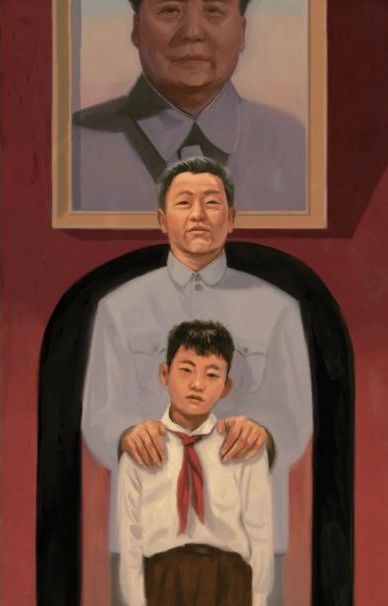
“The fall of Xi Zhongxun was a turning point in Chinese history,” Torigian
writes. It was also a turning point for the Xi family, which spiraled into
tragedy thereafter. Xi Jinping was only nine years old in 1962, when his
father, a senior member of Mao’s government, was purged on spurious charges,
including approving the publication of a novel about his mentor. The elder Xi
was plunged into 16 years of political ostracism and violence—he was beaten so
badly he became deaf in one ear—that continued until the rise of Deng Xiaoping,
in 1978, and the end of the Cultural Revolution. 100YearsCCP1.html
As one former
colleague recalled, Xi’s purge caused him
“psychological damage.” Yet despite all the abuse, Xi continued to insist that
all he wanted to do was to “struggle his entire life for the party.” One is
left to wonder why—and how all the injustices and indignities inflicted on the
Xi family affected his children.
Xi Jinping’s
childhood was so traumatic that being “sent down” to the countryside in 1969 to
spend seven years in grinding poverty and “learn from the peasants” during the
Cultural Revolution came as a relief. Of course, the whole time he lived under
the mortifying shadow of his father, a “counterrevolutionary,” which was one of
the lowest categories of political damnation in the CCP playbook. As Torigian
writes, Xi Jinping “suffered special mistreatment” because of his father, whom
he was forced to denounce. One can only imagine his humiliation as a teenager to have his application to join the Communist Youth League—a precursor to full party membership that every child
coveted—rejected eight times. And then, before the
Cultural Revolution finally ended, his sister, who had suffered her own
torments, hanged herself in despair.
Lest any whiff of pop
psychology tarnish his rigorous scholarship, Torigian insists his book “is not
intended to be a Freudian analysis” of this father-son drama. Instead, he
writes that his intention was to use “the life of one rather unique individual to
tell the story of the Chinese Communist Party in the twentieth century.” By
tapping into new Chinese, English, French, and Russian sources based largely
outside China, Torigian has done that and more. Few sons ever escape the
influence of their fathers, and by just laying out this father-son narrative,
Torigian helps readers gain a deeper sense of how Xi Jinping’s passage to
adulthood made him who he now is.
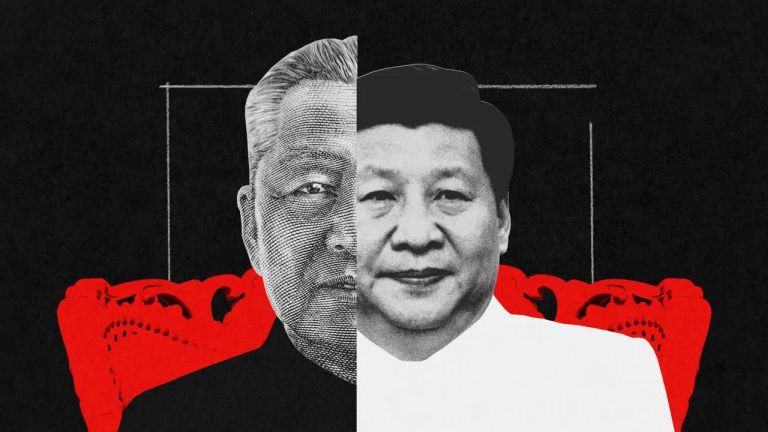
Struggle Session
Xi Zhongxun, Torigian
says, was drawn to the promise of Marxism-Leninism in a manner that was “more
emotional than ideological.” Born to a peasant family in 1913, just after the
abdication of the last Qing emperor, he received only a rudimentary education
in China’s hardscrabble northwest Shaanxi Province. “A tough man with
chauvinistic tendencies,” writes Torigian, Xi Zhongxun
“found motivation in the self-sacrifice and dedication of the professional
revolutionary.” His idealization of the Communist revolution, which began in
the early 1920s, remained a leitmotif throughout his life, even when the party
turned on him in the most irrational and brutal ways.
He first became
caught up in the party’s internecine power struggles in the early 1930s, when
as a young man working with two of Shaanxi Province’s most celebrated Communist
leaders, Liu Zhidan and Gao Gang, he fell victim to a byzantine purge that saw
hundreds executed. Xi was accused of “rightism”—insufficient ardor in executing
“class enemies” such as landlords and rural gentry—and consequently beaten and
imprisoned. Throughout his ignominy, however, he remained steadfastly loyal to
the party and revolution. “I believe that the Central Committee will definitely
clarify this matter,” he optimistically declared. “I absolutely am not a
counterrevolutionary.”
His fate did change
in 1935, when Mao, in need of refuge from his beleaguered Long March, stumbled
into the Shaanxi area and ended the purge. Xi was rehabilitated and assigned to
do “United Front work” with the Nationalists, who had temporarily joined forces
with the Communists to fight the Japanese. Next, he moved to the Communists’
capital, Yanan, where he headed the Northwest Bureau Party School.
Mao’s paranoia about
enemies and desire for ideological uniformity reached hysteria in 1942, when he
launched his “rectification campaign.” At the time, many top leaders, including
Premier Zhou Enlai, were forced to engage in days of humiliating self-criticism
and confession. Xi had been sent to the commercially successful Suide subregion, where he helped organize mass rallies to
expose putative spies, enemy agents, and other imagined political malefactors.
Torigian describes the rallies as generating “a persecutorial mania that
combined elements both farcical and terrifying” and wonders how to definitively
account for such extreme actions by Xi, whom he views as a relative moderate.
“Xi was a party
member,” Torigian surmises, “so when he was told to find spies, he did.” His
goal was to “do everything possible to demonstrate his loyalty to Mao.” As a
result, Mao ended up gifting him a white cloth inscribed with the phrase “The
party’s interests come first,” a token he cherished. Despite all the political
extremism that Xi was forced to endure, however, Torigian describes him as a
person who preferred “balance,” a state that was difficult to find under Mao.
As his career took
off, Xi gained new posts with increasing responsibilities and visibility until
he became known as “the king of the Northwest.” In 1944, however, his
eight-year marriage to Hao Mingzhu, with whom he had three children, fell
apart. The same year, he married the 17-year-old Qi Xin, with whom he went on
to have four more children, including Xi Jinping.
As the Communists
gained ground on the Nationalists in the late 1940s, Xi joined Mao’s land
reform movement, which saw millions of landlords “struggled against” and
executed. He expressed doubts about such tactics and tried to make the case for
a more moderate “middle path.” But this was a time of extremes, and Xi went on
obediently supporting Mao in his next campaign against
“counterrevolutionaries.” Xi even exhorted his minions to “kill enough to
create awe and terror”—a logic, explains Torigian, that presupposed “the party
could somehow achieve a ‘right’ number of executions.”
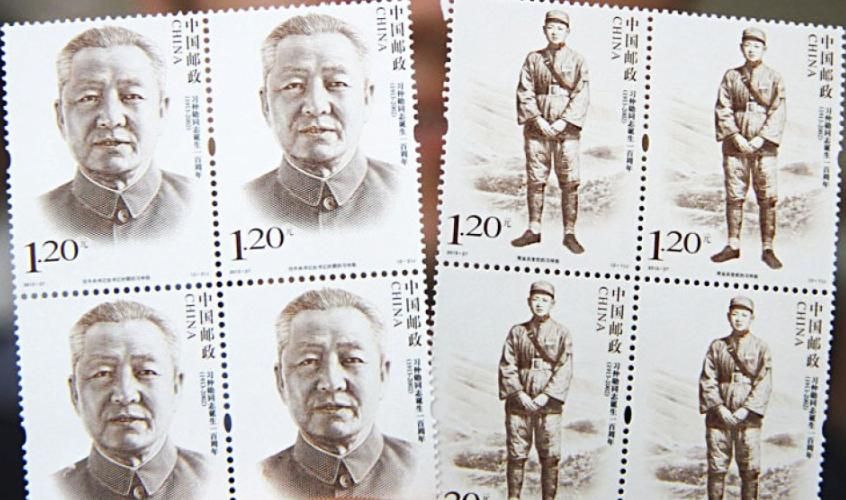
Postage stamps of Xi Zhongxun, Yantai, China, October
2013
After Mao’s People’s
Liberation Army finally triumphed over the Nationalist forces in the Chinese Civil War, in 1949, Xi worked in a
variety of central government positions in the newly established People’s Republic
of China. His posts included minister of propaganda and managing relations with
the Soviet Union, then China’s socialist “big brother.” In 1956, he joined the
CCP’s Central Committee and then three years later became a vice premier under
Zhou on the State Council, the chief administrative branch and national
cabinet. It was there, Torigian reports, that Xi learned that Mao’s impetuous
communization of agriculture, the so-called Great Leap Forward, had created one
of the worst famines in human history and that “Zhou’s priority was not good
policy” but “political survival.”
By 1962, a strange
brew of convoluted accusations laid Xi low once more. Because of Moscow’s
détente with Washington and Russian Premier Nikita Khrushchev’s emphasis on
de-Stalinization, the Soviet Union had become China’s enemy; Mao began to fear
Xi might have become infected by Khrushchev’s “revisionist” virus. Then there
was a novel that Xi had reluctantly approved for publication about Liu Zhidan,
his old mentor from Shaanxi Province, whom some rivals were now criticizing. Xi
was accused of having “illicit relations with Moscow,” approving an incorrect
work of fiction, and being an “antiparty” element. Even after numerous
confessions, self-criticisms, and apologies, he found himself excommunicated
again by the very party to which he’d dedicated his life.
“Thirty-six years of
affection were ruined all at once,” he wrote as the next round of humiliations
began. He felt like “a person who fell off an eighteen-floor building,” he told
a friend.
All this happened
before the Cultural Revolution began, in 1966. As Mao launched his Red Guard
army against the party headquarters and state apparat that he believed were
becoming too bureaucratic and bourgeois, Xi was exiled to a metal-working shop
in Henan Province. There, insult followed injury. Kidnapped by a group of Red
Guards, he was transported to a prison and then paraded before a stadium filled
with detractors, arms bound behind his back, and beaten as the crowd screamed,
“Topple! Set on fire! Deep-fry!” He was later imprisoned, plunged into repeated
struggle sessions, and subjected to more beatings.
In desperation, Xi
wrote pleas to his old comrades Mao and Zhou. Although neither replied,
Torigian notes that Xi “never abandoned his emotional attachment to Mao” or his
devotion to the party. Despite his willingness to repeatedly yield, even
pander, to Mao and the party, Xi still comes across as well intentioned:
someone trapped between submitting and surviving or opposing and being crushed.
The party left no middle ground.
“Down With Xi Jinping!”
In Xi Zhongxun’s
absence, his young second wife mothered their children as well as she could.
But because of her husband’s fallen state, she was put on a “black name list”
at the Central Party School where she worked and soon suffered numerous
physical attacks. This left her children in the painful position of needing
parents who had been rendered unlovable.
“I both could not
stand to look at the black-and-blue scars on her face and was also worried that
my classmates would surround her and look down on her, and I would feel
ashamed,” Xi Jinping’s brother wrote of the embarrassment he experienced when
his mother walked him to school. “I often cried silently out of humiliation for
my mother and family.”
One of Xi Jinping’s
teachers remembered him suffering “extremely unfair treatment” because of his
parents. At his mother’s work unit, for instance, the young Xi was the only one
dragged out with a group of adults to be publicly criticized. The teenager endured
his own mother chanting, “Down with Xi Jinping!” out of fear of more
persecution herself. When Xi later sneaked out of his school one night to run
home and beg his mother for food, she rebuked him and turned him in to the
authorities. At 15, he was brought in for questioning and detention at a
facility where, he later claimed, he “collapsed from sickness” and “even
thought of death.” When, in 1969, he was shipped off as a “sent down youth” to
a penurious village in Shaanxi to do seven difficult years of manual labor, he
felt it as a deliverance.
When Mao died, in
1976, Deng Xiaoping returned to power, and Xi Zhongxun
was finally allowed to return to Beijing. He described his mood as both “joyful
and terrified.” Despite all the official abuse, he still looked on the chance
to contribute to China’s development again as a “glorious mission.” He was
assigned as a deputy provincial party secretary to Guangdong Province and
charged with cleaning up the mess left by the Cultural Revolution. He was also
tapped to help initiate the new special economic zone in Shenzhen, one of four
such zones that Deng had approved to bring in foreign investment and invigorate
China’s lagging socialist economy with market forces. By 1980, Xi was leading
China’s first delegation of governors to the United States.
Xi proved a deft reform leader and gained a reputation for being
open-minded. But even though Xi Zhongxun and his
family were ultimately reinstated, Torigian says that the “problems at the
heart of the Leninist system”—which had allowed their political persecutions in
the first place—remained unresolved. As the CCP amply demonstrated when it
ordered troops to fire on protesters in 1989, the party had not lost its habit
of responding to both real and imagined political challenges in harshly
punitive, often murderous, ways. And so, when Xi Zhongxun
died, in 2002, his children’s generation was left to wrestle with the same
contradictions in China’s political system that he’d found so intractable.
Ten years later, when
Xi Jinping was enthroned as China’s supreme leader, he came freighted with all
the hopes to which his father’s last years in office had given rise. Many
mistakenly thought Xi would follow in his father’s reformist footsteps and that
China might slowly evolve into a more collective form of leadership, adopt a
rule-of-law-based system, and welcome a more liberal economy. Torigian’s book
offers a wealth of clues as to why these hallmarks have not ended up
distinguishing Xi Jinping’s tenure. The Forbidden History.
The Soviet Union’s
collapse at the end of 1991, has weighed heavily on the minds of China’s
leaders over the past three decades as they seek to avoid a similar fate.
The Germans
accomplished such a reckoning, but only after the complete defeat of the
Nazis. And it was not until 1970 that Willy Brandt, chancellor of West Germany,
fell to his knees in apology before the memorial at the Warsaw ghetto. “Faced
with the abyss of German history and the burden of the millions who had been
murdered, I did what we humans do when words fail us,” he later wrote in his
memoir.
Because the CCP is
still in power, China’s challenge is far more difficult than Germany’s. For Xi
Jinping or other party successors to similarly reckon with their country’s
past, they would, in effect, have to take down the
portrait of Chairman Mao that hangs on the Gate of Heavenly Peace in Tiananmen
Square. Such an act would betray the legacy of all those who, like Xi’s father,
devoted their lives to the sacred cause of Mao’s revolution. Xi Jinping
continues to venerate the party and views criticism of its record as
“historical nihilism.” Indeed, it’s unlikely he will ever admit to the
magnitude of crimes it committed against him or his country, much less abandon
the rationalizations he inherited from his father that the revolution’s
travails may have involved excesses but are excusable because they helped forge
a better future for China.
Torigian seems vexed
by this predicament for China. He ends with this line: “Left out of this
narrative is a full account of the terrible costliness in human suffering that
has come along with the revolutionary project—a Faustian bargain seen so
clearly in the life of the man Xi Zhongxun.”
It is not clear
whether Xi Zhongxun understood that to remain a loyal player in Mao’s China, he
had to sell at least part of his soul. But it is clear that
his son, despite all of China’s manifold accomplishments, confronts the
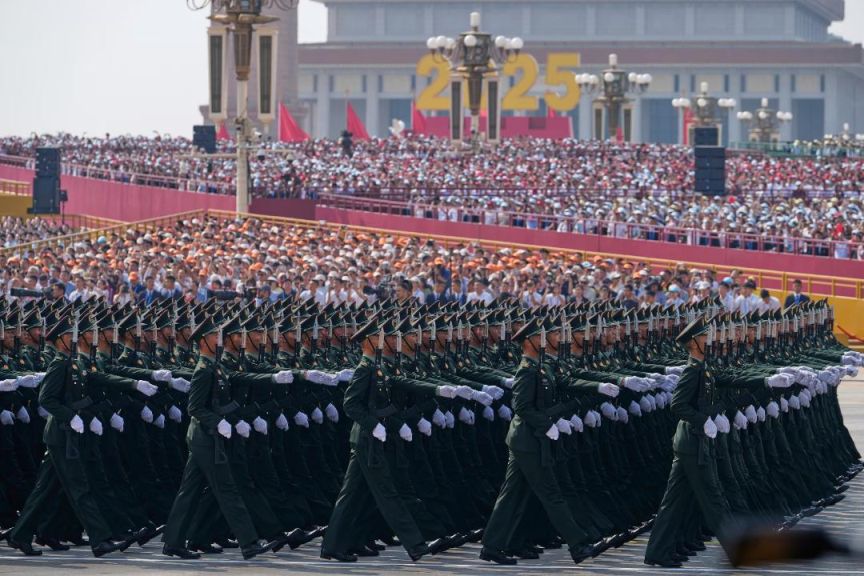
same wager. Standing alongside Russian President Vladimir Putin and North
Korean leader Kim Jong Un, Xi recently declared at a military parade in Beijing
that “the great rejuvenation of China is unstoppable.” Then, sounding almost
American, he proclaimed that “the Chinese people firmly stand on the right side
of history and on the side of human civilization and progress.”
Yet Xi’s declarations
were bereft of any suggestion he’d ever be ready to honestly reckon with the
CCP’s ruinous past. Therein lies the main obstacle to China ever becoming a
truly respectable great power. If Xi were to confront history, he would have to
demolish the party’s pretense that the Chinese Communist Revolution was largely
a benign, productive force. So far, nothing suggests he has sufficient
dedication to historical accuracy to do that. But future generations in China,
those not bound by the same baggage as the Xi family, may someday find their
voice and want to overturn Mao’s old mendacious order. If they do, they may
ironically find it helpful to consider one of Mao’s most iconic slogans:
“Without destruction, there can be no construction.”
Redder
than Red
Torigian recognizes
that “the emotional pressure on a child who was denied participation in the
grand adventure of revolution because of family ties must have been intense.”
But he is wary of addressing the question of what Xi Jinping learned from his
father’s manic odyssey head-on. Although he’d rather let readers come to their
own conclusions, he leaves a breadcrumb trail that is easy to follow.
In what Torigian
describes as “a rare moment of candor,” Xi Jinping once confided, “My father
entrusted me with two things: don’t persecute people and tell the truth. The
first is possible, while the second is not.”
Readers may wonder,
of course, if the first “thing” is not also impossible in modern China. But one
finishes this family saga more fully understanding why, for Xi Jinping, opacity
and mendacity became the best guarantors of survival. “Ironically,” Torigian
writes, “guessing what [Xi] Jinping ‘really thinks’ of his father is difficult
in part because he grew up in the Xi household—a place where a person would
have learned the need for caution and reticence at a young age.”
While the young Xi
was rusticating as a teenager in Shaanxi, he seems to have absorbed one other
lesson: the best protection against being viewed as an apostate was to become
more orthodox than anyone else. As one U.S. Embassy official wrote in a report quoted
by Torigian, Xi concluded that “by becoming redder than red,” he could both
assuage his own embarrassment regarding his father and armor himself against
further criticism.
The more challenging
question than how the father influenced his son, however, is one that lingers
everywhere in this book: What does a one-party state such as China do with a
revolution in which its own leaders—not outside colonialists, imperial
overlords, or exploitative capitalists—became society’s main oppressors, all in
the name of “liberation”? Can such leaders ever be expected to embrace their
government’s past with enough honesty to acknowledge the damage done, much less
make amends?
For updates click hompage here